Addicted to Writing

Manage Your Freelance Writing Career While Writing What You Love

  • About Pinar Tarhan
  • Blog
  • Books
  • Hire Me: Services
  • Contact Me
  • Portfolio
  • Favorite Resources
  • Newsletter

How to Evaluate Your Script Evaluations: My Post on Bang2Write

Posted on June 17, 2015 Written by Pinar Tarhan

In an ideal (and lucky world), your script evaluations would all be positive, and you could start worrying about your pitch after you got your consider or even better, recommend.

But more often than not, you’ll either get a pass or consider with reservations despite your best editing efforts. And different script readers will disagree on pretty much anything.

So you won’t be able to jumpstart editing before deciphering what everyone means, and whether you should consider every tip.

I’m happy to announce that my tips on the subject was published on Lucy V Hay’s Bang2write, a blog I religiously follow.:)

You can click to title to read the article there: 5 Ways To Evaluate Your Feedback by Pinar Tahan aka @zoeyclark


Happy Evaluating!



Filed Under: screenwriting, Writing Tagged With: bang2write, how to evaluate screenwriting feedback, lucy v hay, screenwriting, screenwriting feedback

This Writer Is Getting Smarter About Money: And How You Can Too

Posted on June 5, 2015 Written by Pinar Tarhan

From my Oslo winter trip this year.

The truth is I’ve always been somewhat smart, or at least sensible, with my money.

Despite a brief fascination with Levi’s products in the 90s as I was growing up, I never really had a fascination for brands. As my friends shed their family’s money on Lacoste, Burberry and many other brands I can’t remember, I spent on movies, music and books.

Sure, I bought clothes and shoes and accessories too. Look, I love shopping. I’m just not (that) addicted. Compared to Rebecca Bloomwood, I’m a financial wizard.

I’ve always tried to save some money in case of emergencies, luxuries, trips, future moving plans, even though it’s not always easy doing that.

I’m a freelancer who’s adamant she’ll only take on projects she’s enthusiastic about. Linda Formichelli is right in a way: it’s very difficult if you only try to write about what you love. That’s why I also teach ESL. I’d rather teach English (I love the language, and I love teaching it) than write about something that bores me. I also can’t learn to love something according to the paycheck it provides. I tried.

While I don’t really spend on things I don’t need or don’t care for, there are “luxuries” I refuse to cut back on, such as:

-Nero coffee (Starbucks too, but I like Nero more, to be honest.) And by coffee, I mean mocha. And other stuff I eat and drink while I do my writing at their numerous branches.

– Screenplay coverage: I’ll argue this is more a professional necessity than a luxury, but it costs money. Add to it if you also want it proofread. Add some more for the coverage of your resubmissions, as first submissions are rarely a consider or recommend.

Add even more for other screenplays. You have to have more than one. If not, please stop reading. Bookmark this post, and come back to it after you’ve done some screenwriting. This post isn’t going anywhere. If it does, I’ll let you know.

– Cabs. I love cabs. Granted, I don’t often take them as much as Carrie Bradshaw does. But I certainly appreciate the option.

– Vacation abroad. I need one at least once a year. I can’t always afford it, and it’s not pretty when I go cold turkey.

-Vacation at 5-star hotels/holiday villages. I’ve never been the backpacking or camping type. I like the outdoors as long as it comes controlled, so I won’t have to deal with poisonous or otherwise dangerous animals. I’ve never appreciated tents. And call me crazy, but I do love indoor plumbing and hot water. And food cooked for me. And big, clean pools. You get the idea.

Luxuries I want to have:

– Traveling first class. For the leg space more than anything else, to be honest.

– Rush jobs on my script coverage. Waiting for feedback on your writing sucks. Because let’s face it, we do more waiting as writers than most other folk. We wait for editors, agents, studios, etc. to answer to our original email. We wait for the answer to our follow-up email. We wait a reasonable time to count it as a rejection, we wait for our piece to be published.

We wait.

The problem is writing is personal, even when we do it professionally. We care if people care about our ideas. We get excited if they like the finished product. And chances are, if you are writing fiction, you get even more attached to your ideas. They’re kind of like your babies, admit it. They shouldn’t be, but they usually are.

So if you can get your script coverage faster, why not do it if you can easily afford it? I haven’t really been able to up to now.

– Eating healthier all the time at restaurants that are Monica-clean. Typically, fast food is cheaper and easier to obtain. Unhealthy snacks are usually more available than healthy ones. And by healthy, I mean the natural stuff. And I hate cooking. Damn it!

– A beach house in California.

– More trips aboard, more stays at 5-star places.

– Investing more on my blogs.

– Investing more on courses.

– Going to pitch conferences in person.

-Pitching one-to-one more.

– Working with a story consultant like Marilyn Horowitz

– Work on my pitches with Stephanie Palmer

….

There’s probably more, but those are my top ones at the moment.

How Am I Getting Smarter?

How do I plan on keeping the luxuries I have, making them more frequent and reaching the others?

By making more.

I don’t believe in saving to the point that you stop living and enjoying your life. But I do believe at this point in my life, I can live without 500-dollar-a-pair shoes.

It doesn’t mean some shoes aren’t worth it. It just means it’s a luxury I don’t care for at the moment.

So you can (and should) save according to your own needs and preferences. For more guidance, I recommend I’ll Teach You To Be Rich by Ramit Sethi. I love that book. It’s fun, understandable and practical. It’s slightly more helpful if you live in the USA, but with some research, you can benefit from it no matter from where you are from.

More unbelievably helpful resources on how to make more:

–  The Freelance Writer’s Guide to Making $1000 Extra This Month by Mridu Khullar Relph

– Ramit Sethi offers a lot of free materials to help you make at least 1K more on the side. It’s also a premium course, but I haven’t tried it yet.

– How to Give Yourself an Instant Pay Rise as a Freelance Writer Online by Kirsty Stuart

– How I Got to Write a Regular Column — After My Article Was Rejected on Make a Living Writing.

*None of the links in this post are affiliate links.

This is hopefully only the beginning to a smarter, more profitable life.

*

How do you handle your luxuries? What are your luxuries and money management techniques?

Filed Under: Career Management for Writers, Inspiration and Motivation, Recommended Resources Tagged With: i will teach you to be rich, kirsty stuart, make a living writing, marilyn horowitz, money management, money management for writers, mridu khullar relph, ramit sethi, stephanie palmer, writer luxuries

Grammarly: My Favorite Grammar Checker for Articles, Posts, Stories and Pitches

Posted on May 20, 2015 Written by Pinar Tarhan

Grammarly is an online site that checks your grammar, vocabulary, and style. It has free and paid versions.

The free version grades your writing out of 100 points and gives you a list of areas where you’ve made mistakes and how many. It doesn’t, however, tell you what exactly those mistakes are so you’ve to keep guessing.

When you’re using the paid version, it points out your mistakes and why, as well as offering its correct suggestions. Of course, not all mistakes are necessarily mistakes but stylistic choices you’ve made. You still get graded over 100, and your point gets higher when you correct the mistake or ignore it. (It gives you the option to ignore.)

Now, Grammarly is not perfect. It’s also not human. It’s allergic to passive, for instance. It’s also fond of more formal writing, so it sends out warnings when you end sentences with a preposition or use numbers instead of spelling them. And it doesn’t catch every mistake though it catches a good percentage. Sometimes it suggests you use articles when you shouldn’t or don’t have to.

I don’t recommend using Grammarly without looking at your text once or twice with “editor eyes” yourself. Combine it with the read-out-loud option of your computer or free software like Natural Readers, and you’re golden.

It has saved me a lot of time and increased my productivity. I’ve also recently discovered that you can adjust your settings as creative (novel, script, and other options), so it evaluates accordingly.

Happy Editing!

Filed Under: Productivity & Time Management, Recommended Resources Tagged With: editing tools, grammarly review

The Biggest Dialogue-Related Challenge in Screenwriting

Posted on May 10, 2015 Written by Pinar Tarhan

 “Good dialogue clearly conveys emotions, attitudes, strengths, vulnerabilities, and so on, while revealing the details of your plot and advancing your narrative.”

Susan Kouguell, from her article Tips on Writing Dialogue That’s Truthful. 


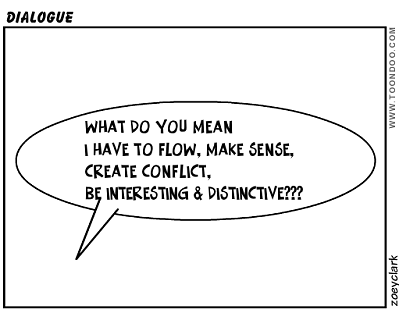
Dialogue is one of the hardest parts of screenwriting. Just look at its functions perfectly stated by Susan Kouguell. Good dialogue needs to do all that.

And what does good dialogue mean?


Complained your dialogue.


  1. Good dialogue flows.

One way to assure that is by not writing on-the-nose dialogue.

But if it’s never on-the-nose, then you’ll also bore your audience to tears or annoy the hell out of them.

Think about five characters who never ever say what they mean and never mean what they say for 90+ pages. Frankly, I’d end up wanting to strangle them. There have been many movies where I hated the characters for this reason.

However if it’s always on the nose, then you’re destroying your chances for conflict. Also a no-no. It’s a hard balance to strike.

Thanks to some great feedback, I (mostly) dealt with my tendencies to write on-the-nose dialogue. In my defense, I don’t want to eliminate it completely because it’s not realistic then either.

Because people who do mean what they say and say what they mean, at least more than half their lives exist. Exhibit A: Me. I might have to get a little diplomatic or more polite depending on the situation, but if something is wrong, I never, ever say “nothing.” And if I’m upset or not happy about something, I never say “whatever.” Yeah, I’m weird like that.

  1. It needs to be fresh. Witty is great too, if you can pull it off (and it fits the mood).

You can’t write a page-turner by putting the same old clichés everywhere. But then again, it should also sound natural.

All the freshness and wittiness in the world can’t save your script if your character doesn’t sound like an actual person. (If it’s not an actual person, say a robot, an alien from another galaxy or some other special circumstance, never mind.)

  1. And perhaps most importantly, your characters should sound distinctive.

Now, it makes sense. Because in reality, we all have unique speech patterns, our preferred catch phrases, speed, ….. The list goes on.

That said, I’ve always found it easier to “separate” the voices for people who are from different backgrounds. Because the more different they are, the easier it’s to write lines that sound unique to that person.

Think about Pirates of the Caribbean, for starters.

Jack Sparrow: pirate, eccentric, (a little) nutty, morally ambiguous, witty, male.

Elizabeth: a young lady with a free spirit. She’s also well-educated and brave.

Norrington: soldier, by the book, with a distaste for outlaws, not usually able or willing to think outside the box.

How hard can it be to write their lines (and how they speak those lines) so that they are distinct? Making the lines funny and/or smart enough can be the challenge here. But differentiating characters’ way of speaking? Not so much.

The Biggest Dialogue-Writing Challenge in Screenwriting 

So what is, at least for me, more difficult than writing dialogue that’s not on-the-nose, fresh and that hopefully flows?

Making my characters sound distinctive, when their backgrounds and life expectations aren’t so different.

What if your story has to have characters of the same background, identifying with the same culture, who are from the same part of the city, who are of the same sex and age?

When writing dialogue for such characters, I rely on their actions and how they respond to situations. I take advantage of their favorite words/catch , how often they swear (or not) and their personalities.

But what I often find, just not within my own dialogue but within others’ as well, is that I can identify characters according to what they say and their actions, rather than how they say their lines.

As I work on my skills to create more distinguishable dialogue, I asked some of my fiction writer friends how they handle this. Their responses are below:

Glenn Hefley:

“Physical actions are good. I like those more than catch phrases — not sure the preference of my readers, but I like them more. Having one start, then stop and think, then finish in a different direction is my favorite separator – equal to the guy who doesn’t reply for longer than is comfortable.”

Gretchen Mure Rodriguez:

“People tend to use certain words (slang or otherwise) more than others or have quirky habits- how they stand, twirl their hair etc.”

Anna Marie Spackman:

“I always think of motivation. My best friend and I may sound similar or say similar things, but we are motivated by different things, so the way we respond to a given situation will be different.”


***

We started with a quote from Susan Kouguell, so let’s end with one from her.

“Readers should be able to identify who is speaking without needing to read each character heading. Characters’ voices must be distinctive and not interchangeable with other characters.”

Susan Kouguell, from her article Tips on Writing Dialogue That’s Truthful.        

*

Yep, no one said being a screenwriter is easy. How do you handle your dialogue? How do you ensure your characters’ voices are distinctive?


Must-Read Helpful Articles on Dialogue

Column D: Writing Dialogue -The Nose Knows by Drew Yanno

6 Reasons Dialogue Is Your Enemy by Lucy V Hay

Tips on Writing Dialogue That’s Truthful by Susan Kouguell

Dialogue Is The Least Of My Problems by Lucy V Hay

Wendy’s LA4HIRE: Best Screenwriting Tips for Great Dialogue by Wendy Kram

More Than Words: Screenplay Dialogue by Lucy V Hay

Script Mistake # 4: Fatty Dialogue by Lucy V Hay

Related Posts Plugin for WordPress, Blogger...

Filed Under: Fiction Writing, screenwriting Tagged With: best screenwriting articles on dialogue, screenwriting, screenwriting tips, writing distinctive dialogue, writing great dialogue

  • « Previous Page
  • 1
  • …
  • 38
  • 39
  • 40
  • 41
  • 42
  • …
  • 76
  • Next Page »

Blogroll

  • My Entertainment Blog

My Other Blogs

  • Beauty, Fitness & Style for the Fun-Loving Gal
  • Dating & Relationships in the 21st Century

Categories

  • Author Interviews
  • Author news and coverage
  • Blogging
  • Book Launches and Excerpts
  • Book News and Author Interviews
  • Book Recommendations
  • Book Reviews
  • Career Management for Writers
  • E-Book Reviews
  • Fiction Writing
  • Fictional Writers: Writer Characters in Movies, TV Series and Books
  • Inspiration and Motivation
  • Marketing
  • Marketing Fiction
  • Movie and TV Series Recommendations
  • Novel Reviews
  • Paying Markets-Web and Print
  • Productivity & Time Management
  • Recommended Resources
  • Reviews for Tools and Devices
  • Romance
  • screenwriting
  • Self-publishing
  • Story Conflicts
  • Website & Blog Reviews
  • Writer Tools
  • Writing
  • Writing Tools
  • Writing Updates

Copyright © 2026 · Focus Pro Theme on Genesis Framework · WordPress · Log in

This website uses cookies to improve your experience. We'll assume you're ok with this, but you can opt-out if you wish.Accept Reject Read More
Privacy & Cookies Policy

Privacy Overview

This website uses cookies to improve your experience while you navigate through the website. Out of these, the cookies that are categorized as necessary are stored on your browser as they are essential for the working of basic functionalities of the website. We also use third-party cookies that help us analyze and understand how you use this website. These cookies will be stored in your browser only with your consent. You also have the option to opt-out of these cookies. But opting out of some of these cookies may affect your browsing experience.
Necessary
Always Enabled
Necessary cookies are absolutely essential for the website to function properly. This category only includes cookies that ensures basic functionalities and security features of the website. These cookies do not store any personal information.
Non-necessary
Any cookies that may not be particularly necessary for the website to function and is used specifically to collect user personal data via analytics, ads, other embedded contents are termed as non-necessary cookies. It is mandatory to procure user consent prior to running these cookies on your website.
SAVE & ACCEPT