Addicted to Writing

Manage Your Freelance Writing Career While Writing What You Love

  • About Pinar Tarhan
  • Blog
  • Books
  • Hire Me: Services
  • Contact Me
  • Portfolio
  • Favorite Resources
  • Newsletter

John Wick: How to Write a Refreshing, Kick-Ass Genre Movie by Picking Your Clichés Wisely

Posted on December 28, 2014 Written by Pinar Tarhan

This is John Wick. You wouldn't want to piss him off. Image via teaser-trailer.com.
This is John Wick. You wouldn’t want to piss him off. Image via teaser-trailer.com.

John Wick, Keanu Reeves’ latest movie to hit the theaters is a fun, fast and exciting ride that deserves it’s current IMDB rating of 7.7 (and more). It accomplishes slick action with a budget of 20 mil, and entertains more than a lot of higher budget, CGI-filled action flicks.

And I’d thought it’d be just another ex-hitman-out-for-revenge movie. Sure, it is an ex-hitman-out-for revenge film, but the way it’s handled motive, dialogue, villains and shootouts make it different enough. Briefly put, it’s kept all the necessary clichés to make the protagonist badass enough with a humane side, but it’s eliminated some really too- frequently-used ones.

For instance, instead of a kidnapped/abused/killed family member or romantic partner, this badass seeks revenge because of the murder of his dog and the theft of his car. It could come across as ridiculous and light, but it doesn’t:

You see, our hitman left the world of crime to be with the woman he loved. Cliché, for sure. But let’s face it, we all love a tough male protagonist with a romantic side. He’s fallen hard, and has had a happy relationship until this woman he loved so much dies of a disease. That’s just one.

Why don’t we take a look at how the film manages to set itself apart? Warning: there will be many, many spoilers. Continue at your own risk if you haven’t seen it.

Not a cliché: Beloved wife doesn’t die by the hand of a bad guy.

But she is/was the only live thing he has cared about, and he’s barely buried her when he receives this cutest dog from her a present: she tells him he needs something to love besides his car. He needs not to be alone, he needs to be loved now that she’s not around. So of course he connects with this adorable puppy.

Now imagine a tough-as-they-come, grieving ex-hitman, right at the start of his mourning, being attacked in his home by a stupid, entitled punk (who happens to be the son of Russian mob boss Viggo) Ioef and his friends. The punks kill Wick’s dog, beat the shit out of him (in John’s defense he had no reason to expect a baseball bat from behind in the middle of the night) and steal his car.

Not a cliché: The (stolen) car shop owner is really pissed at Iosef’ s stupidity when he sees the car: he even punches him.

Not a cliché: Viggo calls the owner, and asks why he struck his son, quite calmly. I’d expect an outrage,  a team of thugs to beat the guy to death, or something. But this one is quite reasonable compared to many other mob bosses we’ve seen. And when the guy tells him that what his son did, he gets mad with his own son.

Not a cliché: The mob boss is actually quite smart (again, when compared to others). He hits his son, and explains why he did a very stupid thing. And before sending men after Wick (before Wick can kill the son), he calls Wick and asks if they can forget about the whole thing.

He knows exactly what Wick is capable of, and is reasonably scared: It’s refreshing to see a mob boss being realistic about who he’s dealing with, instead of thinking he can destroy anyone.

Realism: John goes out of ammunition, and we see him reload his weapon, take his enemy’s weapon or just use whatever is available to him. No endless ammo here.

Realism: John does get hurt. He does call a doctor. The doctor gives him pills to keep him going. So it’s not just adrenaline (or maybe the pills provide just adrenaline; I’m just pointing out he does get chemical help).

He gets hurt again toward the end, almost dying.

Realism: John calls a “cleaning crew” to rid his house of the bodies.

Fun: Cop shows up after a noise complaint: John did take care of 10-12 men after either shooting them or killing them other ways. There was massive struggle. But the cop asks if John is back to work, he says he is just that taking care of something. Cop leaves, knowing exactly who John is (and used to be).

Fun: A lot of the other humor comes from the fact the way some shooting scene are shot: like we see the victim dropping dead from a single shot before we see John Wick moving ahead coolly.

Funny/tragicomic/different: Viggo cares more about his own life than his son’s: he gives away his son’s location to Wick when Wick corners him and kills all the bodyguards. Of course being a man of his word, Wick lets Viggo go.

Cliché we love: Wick survives after everything, having avenged his dog and his wife’s memory. Realistic? Well, in this movie’s universe…kind of, yeah. After all, Wick is who you send after the bogeyman. Bogeyman is scared of this dude.

*

So in terms of reinventing the genre, Wick doesn’t do it. But what it serves the genre with refreshing elements, well-done, non-flabby dialogue; a decent, semi-dark sense of humor; the right music and perfect casting.

The writer (Derek Kolstad) has picked his clichés well: whatever clichés exist, they do a great job adding to the film’s pace and atmosphere.

A touch of realism here and there makes the film more fun, and gets us even more glued to the screen. I recommend this movie to anyone who loves the revenge thriller genre, whether you also write action thrillers yourself or not.

And remember folks, all clichés aren’t bad. If you know which ones to pick and how and where to implement them, they don’t ruin your story: they improve it.

Speaking of working clichés, you might also enjoy the post When It’s OK to Use Cliches in Your Writing: Hidden Metaphors – Poison’s Bret Michaels Style.

Filed Under: Fiction Writing, Writing Tagged With: cliches that work, john wick, john wick for writers, john wick keanu reeves, john wick story, keanu reeves, using clichés in writing, when to use clichés in writing

Age 30 Has Arrived: Plans for My Writing Career & 30’s Milestones of Fellow Writers

Posted on December 15, 2014 Written by Pinar Tarhan

Image via Lhoretsë on Flickr.

Oh my God! Honestly, I can’t believe it. Is it just me, or does time fly faster when you’re enjoying your life? Ever since I quit my full-time job to start writing (I was about 25), time seems to fly faster, despite certain bad situations and obstacles life loves throwing our way.

For instance, I’m writing this post with my two splints on since my nerve entrapment acted up again. But hey, I knew this was a possibility, and I’m taking my own advice whenever I can.

But worry not, this is not a “Crap, I’m getting old(er)!” post. I’m still young, and I believe 30s are the new 20s (40s are the news 30s, 50s are the new 40s…you know how it goes). We are, generally speaking, taking better care of ourselves. We know we don’t have to follow the crowd. We don’t set goals because society expects us to.

Am I, professionally, exactly where I want to be? No, not entirely. Am I taking some necessary steps to make certain goals and dreams a necessity? Abso-fucking-lutely. (Yeah, I’m not the one to swear much, but hey, I’ve just 30, folks! Give me some leeway;))

So what are those goals?

  • Find an agent/publisher for my fun contemporary romance novel.
  • Find a manager and/or a producer/studio for my TV pilot and feature screenplay.
  • Get published in more of my favorite publications.
  • Increase my writing income.
  • Write more in the areas that I love.
  • Interact more with other writers.

So that’s me: hoping to be a better, healthier, more social and more proficient writer. How about you? Have you ever had or set age-related milestones?

Below I’m quoting some of my dear writer friends on what it was like to turn 30 for them and their work:

Will Hiles:

“My first professional story sales happened at 30. Which opened the door to writing for a living.”

 The story is called The Hangman’s Beautiful Daughter. It’s in the horror (vampire) genre, and was published in a magazine called Dead of Night.

I know Will through the Facebook group FWG (Fiction Writers’ Group), and he was one of the first writers to offer me his “30” quote. You can read a lot of his short work on his Facebook author page.

Yvette Carol:

“You and I are approaching milestones at the same time. I’m staring down the big 5-0 like a deer in headlights as we speak. Eeks! I clearly remember that when I turned 30, I decided not to celebrate it as I resisted the idea of ‘getting old’ with such ferocity. And I have to admit, I regretted that decision. Make sure you celebrate the heck out of the moment. Suffice to say, I partied like it was 1999 when I turned 40, and there are big plans afoot for this one. I’ve gained appreciation for aging as I’ve gone along, and I’m not scared to enter my 50’s.

As to where I was professionally & personally at 30, I was recently divorced and had escaped from the city to the country. I was spending many laborious hours in between work shifts painting the illustrations for my children’s books. At that point, I was still determined to write & illustrate my own books. However, as my landlord said, ‘Painting sucks time into it like a black hole.’ And he was so right. I must have spent at least a dozen years of my life illustrating my picture books. It would be another ten years before I’d finally decide to focus on my writing. Although I had many nibbles from publishers along the way, my wonderfully-illustrated picture books still sit in a box under my desk, untouched. I had to learn to let them go. I had to discover a new flexibility as I went along, in order to find what I should be writing. Perhaps those early books will be published when I’m in my dotage, if not, that’s okay as well. It’s all grist for the mill.”

Yvette is a children’s writer and she shares her wise and lovely musings on writing (and her life) on her blog. Yvette and I (virtually) met through the blog of author P.J. Reece, and maintained a friendship based on mutual support and our Zodiac-sign sisterhood. It’s a shame she lives in New Zealand. You can follow her tweets @yvettecarol1.

Glenn Hefley:

“Do you know how long ago that was? I can’t remember what I had for breakfast yesterday. I do remember feeling like it was finally going to start. I don’t recall very clearly what ‘IT” was, but it was there — but I also remember when I was 10, thinking that quicksand was going to be a much bigger issue in life than it has turned out to be. Didn’t seem to matter what TV show you watched back then, there was quicksand ready to gobble someone up. Have you ever seen quicksand? Neither have I. Not once. Very disappointing.

Now I’m coming up on fifty and thinking that it really has started. Finally. I’m at a point were the skills I always wanted to have are at my fingertips. And, I have a worthy direction to hurl my best spears and extend my deepest empathy.

We are such marvelous creatures. Humans, yes, but writers in particular. After all of these centuries, all the changes and the advances — we’re still the only wizards this world has ever had. We are the storytellers. We are the ones who use the words of power to shatter gloom, raise the moon and blind the sun if necessary. We create gods of every sort, one for every taste of the imagination, and every guilty need. With our gods we bend men’s backs and wither women’ s hands. Then we give them absolution. We show them, even after they have tried to find love, and have been beaten and scarred over and over again, that it is still worth the effort.

What will you create this year? It’s got me on the edge of my seat. I feel the coil of emotions ready to strike, and the dance of encounters which will alter perceptions and occasionally smack someone with salmon.

Hell. Quicksand probably wasn’t all that cool anyway. Go ahead and jump. I promise you will love the view.”

Glenn Hefley is a great writer, blogger and (the occasional) editor. He doesn’t shy away from controversial topics or speaking his mind. He was kind enough to give me great support and tips about the first three chapters of my novel and my writing in general. You can follow Glenn on Twitter @glennhefley, or read his blog.

Martin Tracey: 

“At 30 I was writing songs as opposed to books/novels. I wrote a song called Saturn Rising and it won a BBC radio competition which resulted in the band supporting the Fine Young Cannibals in Birmingham. I also wrote a song called Raging Bull, it was a football song about a Wolves player called Steve Bull and it ended up on Old Gold Anthems – the songs of Wolverhampton Wanderers FC I also wrote a song called Horror Story, this laid the foundations I guess for my debut novel Beneath The Floodlights which is about soccer and vampires! I know I have a very active imagination. ”

Martin is a blogger and a novelist who loves music, vampires and football (I couldn’t agree more with the first two!). You can check out Martin’s active imagination and posts on his blog, and follow him on Twitter at @MartinTracey1

*

Go ahead and share your milestones in the comments. 🙂

Filed Under: Writing Tagged With: 30 milestones, glenn hefley, martin tracey, turning 30, will hiles, writers at 30, writing, writing goals, yvette carol

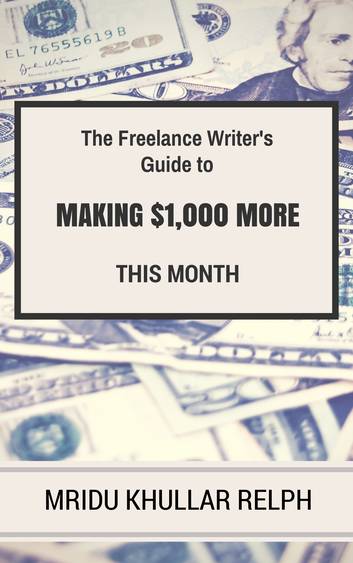
Review for The Freelance Writer’s Guide to Making $1000 Extra This Month by Mridu Khullar Relph

Posted on November 7, 2014 Written by Pinar Tarhan

Image via theinternationalfreelancer.com.


About Mridu Khullar Relph

Mridu is an international writer and reporter who has been published in The New York Times, TIME, ABC News, CNN, Elle, Vogue, Glamour, Marie Claire and Cosmo among others.

In addition to her writer website, she runs the site The International Freelancer where you can read articles about all aspects of being a freelance writer regardless of your location.

About the Book

Her 14-chapter, 66-page book The Freelance Writer’s Guide to Making $1000 Extra This Month is a practical and fun guide to help you make 1,000 more every week from your writing.

And while the book can be used by writers from all points in their career, writers with at least some experience will get the most from it as she states so herself: “The book doesn’t tell you how to start your career or how to make a living from writing, but rather increase your monthly cash flow by a thousand bucks.”

Mridu was kind enough to offer me a review copy.

What I liked Best About the Book

– Every chapter includes her personal experiences; so it’s never just in theory.

– It has specific suggestions, links, tips and even templates you can take advantage of right now.

– Even though some chapters include information you think you know, she has suggestions you either haven’t thought of, or neglect to consider on a regular basis.

– She has a really fun style; you’ll never get bored. And she hasn’t wasted a word.

– There’s a link to an even richer well of resources.


Chapter by Chapter Breakdown

CH: 1 Ask for more is about how you can negotiate better, and she talks about more than just asking for more money.

CH: 2 Do an LOI Blast tells you what LOIs are, when you should send them, and how and why they help you and your career. There’s even a sample LOI, and she also talks about what to include/what to avoid, and when pitching ideas instead might be a better idea.

CH: 3 Focus on the Web is about what kind of publications there are, why you should focus on the web, and how she gets through her web work productively.

CH: 4 Look In Your Inbox guides you on reworking your rejected pieces, how to handle the process and what to pay attention to.

I definitely need to do this more often. This part also reminded me to pitch more regularly.

CH: 5 Send Out Those Reprints is about how (and where) to resell the same piece, and even end up writing original pieces for that publication.

CH: 6 Reslant Your Old Stories includes ideas for how you can reslant your stories, and she has 30 suggestions.

CH: 7 Go international is about selling your work worldwide, regardless of where you live. The books mentions numerous advantages you might not have thought (I write internationally and hadn’t thought of some of them!).

CH: 8 Take From One, Give to the Other is about repurposing: finding another angle in the same story and selling it to a different type of magazine. Once again, Mridu has featured great real life examples.

Ch: 9 Reach out to People is about using your old contacts, and the chapter offers practical ways of reconnecting and more.

CH: 10 Ask for referrals reveals how and when to go about it.

CH: 11 Tap Your Sources is about utilizing forgotten ideas.

CH: 12 Add Value to Your Stories tells you about how audio, video and images enhance your stories

CH 13: Experiment with grants and new media takes a closer look at fellowships, grants, apps, and more. 

CH 14: Get Social on Social Media is about making the most of the social media for your writing career.


How to Make the Most of  the Book

Everyone has her own method of studying, but I definitely recommend printing out, taking notes and keeping it close as a reference. It won’t hurt to return to the most essential chapters (according to your needs), especially during your planning stages.

The book is available on Amazon at $3.99.


*

Filed Under: Recommended Resources, Writing Tagged With: freelance writing, international freelance writing, make more money freelancing, make more money writing, mridu khullar relph, the freelance writer’s guide to making $1000 extra this month, the freelance writer’s guide to making $1000 extra this month review

So What About Professional Novel Editing Services?

Posted on October 19, 2014 Written by Pinar Tarhan

Image via bookaddict24-7.com.

I’ve previously covered various screenplay coverage services on the blog, and I’ll keep updating you on the results. But what about novels? Should we try to get our novels reviewed by professional readers? When should we do it, and how much does it cost?

I have a beta reader who has been immensely helpful with the first three chapters of my novel, both with language and story. A couple of other friends have read and enjoyed the manuscript overall, though I’m not going to claim they were incredibly objective, I’m confident they did have a good time: I know their tastes, and they have read and commented on my stories before. So it was a safe bet.

So far, I haven’t been able to hook an agent, at least not with the first few pages of my story. Now that some of those pages took some rewriting thanks to my beta reader, I’m ready to send more queries and see if I get any requests.

I’ll also probably send the manuscript to Coverage Ink (included in the list below) for an overall review. They reviewed my pilot script before, and I found their comments very helpful, and to the point. And if they made 20 points, I probably only disagreed with (or wasn’t sure about) 2 of them, which means they got what I wanted to do with my story.

That’s one of the most important aspects of coverage for me: for the reader to be as objective as possible, comment on the marketability of the story and suggest ways on how to make the story catchier and irresistible, without changing its heart. I tried Coverage Ink after hearing about them via Stephanie Palmer’s Good in a Room blog. I’ll also resubmit the pilot after completing my editing.

They also offer proofreading services, and if you can afford it, I strongly recommend getting your story proofed as well as critiqued by people you trust.

So without further ado, below are some of the services you might consider starting your research with:

*(Please note that with the exception of Sigrid’s e-book, I haven’t used affiliate links in this article.)

– Writers & Artists:

Their services come in several stages, so you can send in anything from your first draft to final. Full manuscript review ranges from £680 – £1020. They also offer other packages, so do check out their site for more information.

– Sigrid Macdonald:

Sigrid is the author of Be Your Own Editor. I own this e-book and I’ve found it tremendously helpful. While it wouldn’t substitute for Sigrid reading every page herself, it’s a great alternative when you can’t afford editing services.

– Coverage Ink:

Coverage Ink offers different levels of coverage, so be sure to check your options out. You might also want to get a quote for your novel by submitting the first 5 pages.

– Writer’s Digest:

Writer’s Digest Shop offers manuscript critique for your novels. It’s currently 3 dollars per page.

*

Please keep in mind that this is not meant to be a comprehensive list, just a starting point for your research.

If you have tried editing services, please share your experiences in the comments.

Happy Editing!

Related Posts Plugin for WordPress, Blogger...

Filed Under: Fiction Writing, Writing Tagged With: novel editing, novel editing services, professional novel editing

  • « Previous Page
  • 1
  • …
  • 40
  • 41
  • 42
  • 43
  • 44
  • …
  • 76
  • Next Page »

Blogroll

  • My Entertainment Blog

My Other Blogs

  • Beauty, Fitness & Style for the Fun-Loving Gal
  • Dating & Relationships in the 21st Century

Categories

  • Author Interviews
  • Author news and coverage
  • Blogging
  • Book Launches and Excerpts
  • Book News and Author Interviews
  • Book Recommendations
  • Book Reviews
  • Career Management for Writers
  • E-Book Reviews
  • Fiction Writing
  • Fictional Writers: Writer Characters in Movies, TV Series and Books
  • Inspiration and Motivation
  • Marketing
  • Marketing Fiction
  • Movie and TV Series Recommendations
  • Novel Reviews
  • Paying Markets-Web and Print
  • Productivity & Time Management
  • Recommended Resources
  • Reviews for Tools and Devices
  • Romance
  • screenwriting
  • Self-publishing
  • Story Conflicts
  • Website & Blog Reviews
  • Writer Tools
  • Writing
  • Writing Tools
  • Writing Updates

Copyright © 2026 · Focus Pro Theme on Genesis Framework · WordPress · Log in

This website uses cookies to improve your experience. We'll assume you're ok with this, but you can opt-out if you wish.Accept Reject Read More
Privacy & Cookies Policy

Privacy Overview

This website uses cookies to improve your experience while you navigate through the website. Out of these, the cookies that are categorized as necessary are stored on your browser as they are essential for the working of basic functionalities of the website. We also use third-party cookies that help us analyze and understand how you use this website. These cookies will be stored in your browser only with your consent. You also have the option to opt-out of these cookies. But opting out of some of these cookies may affect your browsing experience.
Necessary
Always Enabled
Necessary cookies are absolutely essential for the website to function properly. This category only includes cookies that ensures basic functionalities and security features of the website. These cookies do not store any personal information.
Non-necessary
Any cookies that may not be particularly necessary for the website to function and is used specifically to collect user personal data via analytics, ads, other embedded contents are termed as non-necessary cookies. It is mandatory to procure user consent prior to running these cookies on your website.
SAVE & ACCEPT