Addicted to Writing

Manage Your Freelance Writing Career While Writing What You Love

  • About Pinar Tarhan
  • Blog
  • Books
  • Hire Me: Services
  • Contact Me
  • Portfolio
  • Favorite Resources
  • Newsletter

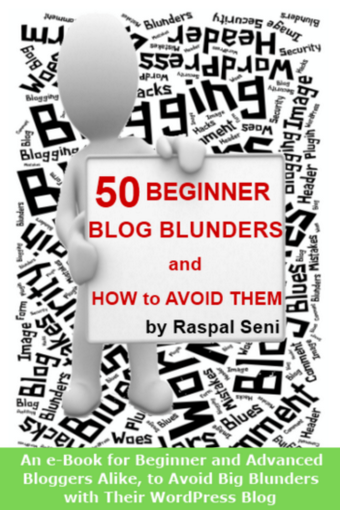
Review for The 50 Beginner Blog Blunders And How To Avoid Them by Raspal Seni

Posted on August 8, 2014 Written by Pinar Tarhan

raspal seni

Raspal Seni is a freelance blogger specializing in WordPress and technical computer stuff that a lot of us dread. You can learn more about him through his blog I Write About Blogging where he helps out beginner bloggers.

The e-book:

Having been blogging for over 4 years, I frankly didn’t think I’d be finding more than one or two blunders on my part. I was wrong. I thank my friend Raspal for making such a thorough guide. This is a review of the highly useful e-book.

There’s a chance you are making at least several mistakes yourself, so let’s go over the contents of the book:

Categories

1. Comment Form Blunders

From moderation to allowing comments at all, this part covers everything you need to check for a more user-friendly blog. You may not agree with everything, or you might have to commit some of them due to the popularity and/or topic of your blog (such as not allowing comments at all).

I enable comments on my blogs, but despite warnings, some threads might get too heated (and not civil!) and you might be better of disabling comments on certain posts.

However I’m a big believer in community, and interacting with your audience through comments, as well as letting them interact with each other, usually does work wonders for your authority and blog engagement levels.

So make sure you aren’t making any unfortunate mistakes when it comes to your comment form.

2. Security Blunders.

You are probably way too past the need to be reminded to make your password tougher to crack, e.g. not using obvious stuff like your age, birth date, your name, your pet’s name…etc. But what about changing the username from admin?

I tried to change my username from admin, and it got so complicated that I had to quit. But with Raspal’s method, it’s no hassle, and your WordPress blog you worked so much for is more secure. Isn’t it fun making hackers’ lives more difficult for a change?

3. WordPress Plugin Blunders.

I love that WordPress comes with so many Plugin options, but this means you need to update them regularly (for security reasons, and for the plugins to work properly with your constantly updated versions of WordPress.)

But there’s more upkeep you need to do, such as getting rid of useless plugins, testing new ones, avoiding certain ones and more. Raspal covers them all in 9 different subsections.

 4.  Image Blunders.

At this point, even the newest bloggers know they need pictures. And many know they need good pictures. The problem is, quality pictures can take up a lot of space, leading to slow uploading of your site. You might also get in trouble if you’re not crediting them properly, or using pictures you aren’t allowed to use.

From formatting to attribution, from keywords to resizing, he goes over everything you need to know and do when it comes to using images on your blog.

This part has 15 subsections.

*

All in all, The 50 Beginner Blog Blunders And How To Avoid Them (affiliate link) is a highly practical e-book you need to have if you still have doubts and complaints when it comes to your blog uploading speed, security, traffic and more. The book will help you tackle a lot of these issues and improve your blog.

You can follow Raspal on Twitter too!


Buy Now

Filed Under: Blogging, Recommended Resources Tagged With: blogging blunders, blogging mistakes, tips for using images for your blog, wordpress comment form tips, wordpress plugin tips, wordpress security tips

Searching for The Ideal Script Coverage/Consulting for Your Screenplay

Posted on July 5, 2014 Written by Pinar Tarhan


script coverage
Image via 3rentertainment.com

I’m guessing you aren’t already an established screenwriter with industry connections. Maybe you don’t even live in L.A.

I’m also assuming you wrote and edited that screenplay. Maybe you pitched, and nobody bit. Maybe you entered some contests, and your results didn’t earn you the industry attention you were hoping for.

You also don’t have (m)any screenwriter friends who can offer you solid advice. Or maybe you do, but their style and taste are far too different for you to take advantage of this.

You want professional opinion of someone who knows what they’re talking about, but you can’t decide where to begin.

You aren’t alone. I want detailed feedback on my screenplays, but there are many options out there. Offers and prices vary greatly.

So while there are far more services than I can cover in a single blog post, I’m sharing the ones I’m considering using myself.

Now, ideally, you’d want the most honest, detailed, relevant yet encouraing feedback from someone who you could afford.

None of the links in this article are affiliate links. This article exists to make your (and my) quest on finding the ideal coverage service a little easier.

What’s screenplay coverage/consulting exactly, anyway?

Very, very roughly, it’s an evaluation of your script’s strengths and weaknesses. However the length, depth and contents depend from service provider to service provider.

Of course more details and pages usually mean more money. Some even offer marketing packages. Some offer their industry position   (pass/recommend/consider), etc.

Now that we’ve covered that, let’s start with the Blacklist.

The Blacklist

I plan to write a separate entry detailing Blacklist and my experience on it.

But for this article, what you need to know is that Blacklist is a popular screenplay hosting-evaluation site where you can host a single script for 25 dollars a month.

You fill in your logline, keywords, genre and a lot of other information, such as your agent (if you have one), how many episodes you are planning (if it’s a TV show, etc…)

Now, you want your screenplay to be highly visible, and for that it needs a high average score of 8 or upwards after being evaluated by at least two of their readers.

Evaluations cost 50 bucks a screenplay, and they are a page-long descriptions of your strengths and weaknesses, budget (low/high/medium) and a logline written by the reader, and some tips on what to improve .

Those lucky souls who get 8 (over a scale of 10) or above are promoted within the site, and a lot of Blackist favorites have been made into movies. You should remember that 8 needs to be the average of all areas, and you’re graded on the plot, premise, characters…..

The problem is, it is pretty difficult to score that high. Even if your story is strong, this is a highly subjective matter. And getting one or two bad scores shouldn’t put you down.

However with two low/average scores and a couple of months of no/little traffic (more on this on the upcoming post), it might be time to spend money elsewhere and take your project(s) down.

Mind you, this isn’t me being pessimistic. The site’s own guidelines suggest this.

Of course there’s a chance that even if your screenplay hasn’t scored high, the keywords you used to describe your projects can help you get found by industry professionals.

I might try Blacklist again for another project of mine, but for the time being I’m adhering to their advice and will suspend my account for the current ones.

Bluecat Screenplay Contest and Screenplay Consulting

I gave some details about this contest in my previous post The Elusive Craft of Writing Better Screenplay Dialogue & Useful Resources to Improve Yours.

The contest sends your written feedback in a month, and after that you are allowed to resubmit (only once) before a certain deadline, should you choose to make the changes requested. So if you’ve entered earlier, $55 will give you a contest entry, and about a page of written analysis. After that you can resubmit for an extra $40 (or more, depending on when you submitted).

I’ve recently received my feedback, and I’m quite happy about it. Sure, there are elements that made me panic a little. For instance, I was told my characters were prone to saying exactly how they felt (as opposed to hiding it, expressing through actions, or saying the opposite…)

And the thing is, I edited very harshly before submitting it to this competition. The script was at its shortest version, and I had cut a total 7 pages of dialogue and description, following Gordy Hoffman’s (and other respected experts’ advice on dialogue).

That said, this was the first review where I felt the reader and I are on the same page when it comes to what the story is about, why my protagonist is acting in a certain way, and who he is, and how the characters are interacting the way they are interacting.

And I’ve gotten so used to killing darlings (do Stephen King’s ears ring every time writers use this phrase of his?), I’m sure I can kill some more on my next editing spree.

The great thing about the Bluecat site is that there’s lots of great tips on all aspects of screenplay writing. The only cost is your time (and attention, obviously).

You can also choose to join workshops or get script consultation by the Gordy Hoffman (Bluecat Founder and Contest Judge). The downside is, if your script has been evaluated by him, it can’t enter the competiton, which is only fair.

Doug Davidson (Four Star Feedback)

Doug is a freelance writer, screenwriter and Nicholls fellow.

He’s affordable, friendly, and open to questions. He also offers a fixed price/service, so you won’t scratch your head for long. He has posted a sample review on his webpage, and I do like his approach and tone.

His rate is $100, and you get several pages of feedback on what works and what doesn’t.

Happy Writers Stage 32 

My screenplay got to be a quarterfinalist in the Happy Writers at the last competition (before they merged with stage32).

I also love the network of Stage32 (which is also where I met Doug Davidson).

The great thing about Stage32HappyWriters is that it’s free to join. You can connect with other writers and entertainment professionals, learn from your peers as well as more experienced veterans. Helpful posts are frequently published, and there are lots of informative discussions going on.

There are also labs you can attend for a fee.

The good thing about Stage32HappyWriters’ coverage service is that you have several alternatives to choose from. The readers’ credits have been listed, and you can choose a reader whose work you already admire.

Sellingyourscreenplay.com

Ashley Scott Meyers is a working screenwriter with IMDB credits to his name, and he runs a very helpful site loaded with screenwriting tips, including writing better, networking and how to sell your screenplay.

In addition to his free e-mail course (5 emails, an email per week upon signing up) on how to sell your screenplay, the site also features a screenwriting library where you can download actual scripts of movies for free, though mostly they aren’t the shooting scripts. Still, it’s a great resource.

Sellingyourscreenplay.com also offers a premium membership where you can join classes.

As for coverage services, you can choose one of the industry specialists (whose resume highlights are listed) on the page to evaluate your script.

Page Awards

Page Awards organizes a yearly TV script/movie screenplay contest. You can choose to get professional feedback before submitting your screenplay to the contest, or you can do it without entering the contest.

They have several packages to choose from. What I like about their packages is that you can even choose to get a marketing package where they write your synopsis, query letter and logline.

They also have a very nifty newsletter that offers tips, links to resources and several calls for the types of screenplays studios/executives/producers are currently looking for.

Page Awards also lists the accomplishments of their previous winners, and that alone usually fires you up, and want to enter.

I entered one feature screenplay and one TV pilot (drama, one-hour) this year. They are a couple of weeks away from announcing their quarter finalists, so please keep your fingers crossed for me.

Scriptapalooza

Scriptapalooza is respected competition for both TV pilots and screenplays. Like many competitions, you can get your judge’s feedback for an additional fee. You can also just enter the competition, or skip the competition all together and order a consultancy service.

David Trottier

David Trottier is the writer of Screenwriter’s Bible, and also called Dr. Format. His website Keep Writing comes with great articles.

He also offers query evaluation, courses and workshops.

His script consultation comes in different packages ( 14 Point analysis, one sheet or synopsis, first 10 pages…..), and the prices vary greatly.

Specscout

Specscout has a fixed service rate for feature film screenplays (you can’t yet get analysis for TV shows yet.)

Their coverage costs $197, but the price includes the detailed evaluations of 3 professional reader. And should you score a 70 over 100 and higher, you can list your script on the site for free, and forever.

You can also see what scripts have sold, and by whom.

Sample evaluations, along with their scores in every area, can be viewed on the site.

*

Important End Note: 

Remember your favorite movies. Remember your friends’ favorite movies. There have likely been arguments on what’s better, and why. One friend might find your adored “masterpiece” mediocre, and you can question your friends’ sanity/logic/taste for loving the movies they do.

Remember the different kinds of movies that have become box office hits and/or award favorites.

Even if you get a very pessimistic review, or get pessimistic after what you read, you should remember the objectivity of it all.

One person’s genius is another person’s what-the-hell.

So keep writing. Keep editing. Keep studying and pitching.

And please share your results and experiences in the comments if you have tried any of these consulting services.

Filed Under: Fiction Writing, Writing Tagged With: dave trottier, doug davidson, finding the perfect script coverage service, page awards, script consulting, script coverage, spec scout, stage32, the blacklist

The Elusive Craft of Writing Better Screenplay Dialogue & Useful Resources to Improve Yours

Posted on June 18, 2014 Written by Pinar Tarhan

jack nicholson, a few good men
Famous line from A Few Good Men starring Tom Cruise and Jack Nicholson. Written by Aaron Sorkin. Image via whatascript.com


Actor/director/screenwriter Ethan Hawke (Before Sunrise series, Training Day, Dead Poets Society) is quoted to have said dialogue writing is easy; you just have to be honest. While I agree with Hawke that honesty is a must, I don’t necessarily think it makes your job a breeze.

You see, I’m honest to the core when I’m writing a screenplay. I try to keep my characters honest too (as long as they are not delusional, dishonest or just plain evil in nature). And this sometimes causes problems. For instance my dilaogue can be viewed as lacking subtext, and my characters being too precise at expressing themselves.

While I appreciate the importance of subtext, especially when it’s needed to create tension and/or mystery, I’m not a big fan of characters being vague, evasive, or sarcastic just because. Is it wrong to have characters that aren’t afraid of speaking their minds, or characters that are just forthright during their emotional outbursts?

Yes, not all people are like that. But not all people (or great characters) are evasive. I just try to do what works for my story. (It’s not to say upon a reviewing of my script I didn’t make add more subtext, I did.)

But while screenwriting has many, many delightful moments, it also has excruciating ones. I’d love to pick Hawke’s brain on how he made his process so smooth, as I mostly love the writing he does.

And since honesty doesn’t do the trick alone, let’s get some more help on how to write terrific dialogue from the articles below:


How to Win BlueCat by Gordy Hoffman

Gordy Hoffman, who is a screenwriter/screenwriting consultant and the founder of BlueCat Screenplay Writing competition, offers tips that work not just on a competition level. They also serve as great guidelines to edit/rewrite your entire screenplay.

His tips include getting rid of bad jokes, unnecessary/flowery description, making your script as tight (and as short) as possible, rereading and more.

Gordy Hoffman’s screenwriting credits include Love Liza, an offbeat drama comedy starring Philip Seymour Hoffman.

*Note on BlueCat: BlueCat offers something more than your typical contest: written feedback on every submitted script. And if you get to submit before a certain deadline, you can resubmit your edited screenplay. You need to pay for the resubmission, but it’s still a great way to improve your writing, as well as your chances to win.

You can of course disagree with the comments, and choose not to resubmit.

I’ve entered with a feature drama script, after editing an already edited version. This new version is 7 pages shorter, has more subtext and is much tighter. I’m looking forward to the feedback. We’ll see whether I’ll resubmit afterwards.


The Heart and Soul of Screenwriting: Writing Good Dialogue and Description

Also penned by Gordy Hoffman, this article reminds you that you’re writing a screenplay, and not a novel. If you’ve gotten used to killing your darlings in your writing, it’s good news. Because you’ll be killing more darlings than ever.

It also reminds you of the required balance between dialogue and description. You shouldn’t have too much of either. Of course while some screenplays can be exceptions, yours might not necessarily be one of them.

So basically, be coherent and succinct. Give it your best shot. And don’t forget to read the entire article.


SCREENWRITING TIPS FROM A SCREENPLAY CONTEST JUDGE

A judge of the BlueCat contest offers tips that will be useful for getting better contest results. But applying these will make your script more marketable.

Yes, it warns you against typos and grammar mistakes, and doesn’t diverge from Hoffman’s views on dialogue and description. But it also offers some great guidelines when it comes to exposition, using your imagination and more.


How To Write Screenplay Dialogue by Rob Tobin

Rob Tobin is a script reader, doctor and exec who has gone over thousands of scripts.

I love this article because he believes great dialogue writing is a skill that can be learned and improved. He makes his case through a movie that won the Oscar for Best Screenwriting in 1998: Good Will Hunting.

Written by Matt Damon and Ben Affleck, and directed by Gus Van Sant, Good Will Hunting is a delightful movie experience by itself. However, it is, as pointed out, a great screenplay to study as well.

The characters and their lines are often nothing short of brilliant. And the clip of the scene, most mentioned for masterful dialogue, is available on YouTube.

That scene is one of the most memorable scenes in the movie as the trouble-prone Will (Matt Damon) saves his best friend Chuckie (Ben Affleck) from humiliation, and potential jail time (as Chuckie would have proceeded to kick the pampered ass of the meddling Harvard student) just with his self-read and self-earned wisdom and education. This scores him the phone number of one of the girls Chuckie was trying to impress, the satisfaction of having shoved to one obnoxious character (we also cherish the feeling as the audience), as well as showing an interesting irony: Will can’t get out of trouble himself. Let’s be frank, we often crank out some wise advice, while we can’t or don’t follow it ourselves.

As Tobin suggests, it is crucial to know your characters very well. I’ll leave you with this great quote from the article: 

“So you want brilliant dialogue? Make it the only dialogue your character can possibly say given who he or she is, where he or she is, and to whom he or she is saying it.”

Filed Under: Fiction Writing, screenwriting Tagged With: ben Affleck, bluecat screenplay competition, good will hunting, good will hunting screenplay, gordy hoffman, how to improve your dialogue writing, how to write great screenplay dialogue, matt damon, rob tobin, writing good screenplay dialogue, writing great screenwriting dialogue

Review for Kirsty Stuart’s E-book: How to Start a Travel Blog and Make Money

Posted on May 5, 2014 Written by Pinar Tarhan

Some things in life are just amazing and should be experienced, such as:

–       A rocking stadium concert by an artist you adore (and by that I mean you know pretty much all the songs), where you are ideally close enough to the stage so you don’t just watch things from the big screens.

–       Writing at least one story where you pour out your soul. Whether it’s fiction or non-fiction is irrelevant. And since you are a writer, chances are, there’ll be tens of stroy ideas where can you share bits of your soul. Don’t hold it in;)

–       Dancing to one of your favorite songs without caring about anyone or anything else.

–       Finding your favorite spot/city/country.

And probably the most important one for us writers:

–       Making a living writing about a topic you truly enjoy. And most of us love traveling. We just happen to run out of money or time to do it as often as we’d like.

What if we could make enough money travel writing? Whether it’s from your own travel blog(s), writing for others or a combination of these, you can start your travel writing career. But if you feel stuck, or not quite sure where to start, I’ve just the resource for you.

Travel writing is easy – if you are writing for yourself.

It’s writing with the right voice, for the right audience and with the right structure that’s hard. Finding ideas and the right markets for them can be challenging, just like any other writing market.

Finding unique slants can be even more difficult in this niche. After all, it has existed for a long time, and pretty much everything has been covered. Luckily, no one covers anything like you. It does help, however, when you can take advantage of a savvier writer. It makes the climb to success less daunting, and a lot more fun.

Image via freelancewritersonline.com


One of those savvier writers is the lovely Kirsty Stuart, and the recommended resource is her e-book How to Start a Travel Blog and Make Money. This e-book comes with 69 pages featuring:

  • practical tips and experiences from other expert travel bloggers,
  • Kirsty’s own story,
  • how to start and run your travel blog (including which pages you should have and what information each page should contain),
  • examples of thriving travel blogs,
  • how to find ideas,
  • how to find an audience,
  • how to manage and deploy social media for your travel blog,
  • earning money with information products (including tips on how to market them),
  • earning money with affiliate marketing,
  • sponsored posts and paid trips,
  • advertising on your blog (along with pros and cons),
  • how to pitch to publications and other clients,
  • list of some travel writing markets,
  • earning from blogging for others (as well as additional services you can offer),
  • writing an awesome travel post,
  • finding work when you need to,
  • inspirational quotes,
  • tips to kill your fears and feel encouraged.

Why I loved the book (besides the awesome content, of course):

  • it’s great for anyone who wants to write full-time about a topic they love, not just travel. The tips can be applied to any niche, but it is a lot more specific if you are interested in travel writing and blogging since she provides so many relevant tips, resources and first-hand experiences.
  • the lifestyle mentioned, and how she came to choose travel writing, is easy to identify with: she calls it the struggle to adapt after you’ve been traveling a long time. I call it post-Erasmus depression. (or blues, if you are having an easier time.This shall be one of my future travel posts!)
  • it’s honest.
  • it’s comprehensive. It fills you in about the effort level from the beginning. And you don’t need to be a beginner blogger to take advantage of it.
  • it’s fun. I’m big on fun.
  • it offers places/ways/markets you can find travel blogging work.

Oh, did I mention the price is £2,99 ? You can check out Kirsty’s site Freelance Writers Online for more useful tips on freelance writing. And you can check out one of her own travel posts: Must-See Temples in Chiang Mai.

She was also kind enough to answer my questions on travel writing.

Kirsty on writing about politically “hot” countries:

“I personally write travel articles for companies like Viator and Flight Centre, and while I’m sure they wouldn’t want me to cover up any truths, their business is promoting travel! They want people to travel – it’s in their best interests – so for clients like this I don’t really write about political instability or anything of that nature. They’re not news sites so it’s not really relevant.”

Kirsty on whether or not great stories have an expiration date (because what if you had a breath-taking experience years ago and you are only writing about it now?):

“I don’t think travel stories have an expiration date, no. Those tremendous experiences and stories need to be told! If there are details that I feel could have changed – the cost of a visa at the land border between Thailand and Cambodia springs to mind – then I’ll just say that. Something like, “It cost $20 USD (at the time of writing)” should cover it. If there’s a good story there, don’t let the passage of time prevent you from telling it.”

*

Even though some of the first articles I sold in my freelancing career were travel articles, I had somehow gone into a writer’s block-induced hiatus. But after going over the book for the second time, I made a plan, and made my “returning” travel pitch. It’ll hopefully lead to other ideas and acceptances.

Let me know what you think about traveling, traveling writing and the e-book🙂


Related Posts Plugin for WordPress, Blogger...

Filed Under: Blogging, Recommended Resources Tagged With: freelance writers online, freelance writing, kirsty stuart, make money travel blogging, make money travel writing, travel blogging, travel writing

  • « Previous Page
  • 1
  • …
  • 42
  • 43
  • 44
  • 45
  • 46
  • …
  • 76
  • Next Page »

Blogroll

  • My Entertainment Blog

My Other Blogs

  • Beauty, Fitness & Style for the Fun-Loving Gal
  • Dating & Relationships in the 21st Century

Categories

  • Author Interviews
  • Author news and coverage
  • Blogging
  • Book Launches and Excerpts
  • Book News and Author Interviews
  • Book Recommendations
  • Book Reviews
  • Career Management for Writers
  • E-Book Reviews
  • Fiction Writing
  • Fictional Writers: Writer Characters in Movies, TV Series and Books
  • Inspiration and Motivation
  • Marketing
  • Marketing Fiction
  • Movie and TV Series Recommendations
  • Novel Reviews
  • Paying Markets-Web and Print
  • Productivity & Time Management
  • Recommended Resources
  • Reviews for Tools and Devices
  • Romance
  • screenwriting
  • Self-publishing
  • Story Conflicts
  • Website & Blog Reviews
  • Writer Tools
  • Writing
  • Writing Tools
  • Writing Updates

Copyright © 2026 · Focus Pro Theme on Genesis Framework · WordPress · Log in

This website uses cookies to improve your experience. We'll assume you're ok with this, but you can opt-out if you wish.Accept Reject Read More
Privacy & Cookies Policy

Privacy Overview

This website uses cookies to improve your experience while you navigate through the website. Out of these, the cookies that are categorized as necessary are stored on your browser as they are essential for the working of basic functionalities of the website. We also use third-party cookies that help us analyze and understand how you use this website. These cookies will be stored in your browser only with your consent. You also have the option to opt-out of these cookies. But opting out of some of these cookies may affect your browsing experience.
Necessary
Always Enabled
Necessary cookies are absolutely essential for the website to function properly. This category only includes cookies that ensures basic functionalities and security features of the website. These cookies do not store any personal information.
Non-necessary
Any cookies that may not be particularly necessary for the website to function and is used specifically to collect user personal data via analytics, ads, other embedded contents are termed as non-necessary cookies. It is mandatory to procure user consent prior to running these cookies on your website.
SAVE & ACCEPT