
Addicted to Writing

Manage Your Freelance Writing Career While Writing What You Love

  • About Pinar Tarhan
  • Blog
  • Books
  • Hire Me: Services
  • Contact Me
  • Portfolio
  • Favorite Resources
  • Newsletter

The Truth about Passive Income: It’s not usually such a passive way to make money!

Posted on May 29, 2011 Written by Pinar Tarhan

passive income
Image via michaelkwan.com

I recently earned a commission through a sale (that came from my review of) of Paul Cunningham’s How to Be a Successful Freelance Blogger e-book. On the surface, I made money through a link on my website, while somebody else wrote a great e-book. You got to love passive income, right?

Not so fast, folks! I didn’t just randomly drop a link for Paul’s book. I bought it myself, because hey- the title and the content really appealed to me. I read, re-read and studied the book. His content went into 3 categories for me: 1) stuff I already knew and applied, 2) stuff I knew yet I needed to be reminded of to apply, and 3) stuff I learned from him.

So in addition to keeping this e-book near to serve as a guide at all times, I wrote a review and then posted on my blog. Then, I promoted the post. Then, I promoted the blog. Then, I kept promoting the blog, because when you have a blog, you have to keep promoting it.
So, while passive income is one of the most attractive terms of making money online, trying to make it happen is definitely not a passive activity. Passive income streams do not get formed overnight and it usually takes a lot of time and effort, until you start making money “passively”.

Some of the most popular (passive) income streams:

– Revenue from your web writing:

Content Farms: The concept almost all writers hate: When you first start out, you only make a few pennies. The more articles you publish, the better chance you stand at getting more page views and ending up making more money. But writing for the web is not a passive activity, especially if you want to make the most of your material. You write, edit, format, optimize, publish and promote. As more content is published, you will realize that your earnings are increasing.

– Writing for other blogs & websites: While many writing jobs pay by post, some offer an additional revenue share bonus (where you get a percentage of their advertising revenue), and/or a popularity bonus which grants you extra bucks if your blog reaches a certain traffic/bookmarking level, etc… So when you are supposed to get a revenue share, it helps if the blog you write gets extra traffic. Oh, and to reach a level of popularity, you need to promote it yourself.
Supposedly, you sit back and watch your revenue & popularity grow. In reality, a post hardly makes it very big without any effort from your end. And remember, it is usually also up to you to create that great content, optimize it for the search engines, and then let the world know about it.

Affiliate Marketing:

Making Money through Other People’s Products (& Services):
Sometimes, making money from affiliate marketing can be as simple as leaving your own affiliate link in an article. But not everyone who reads that article will sign up. Also keep in mind that some affiliate sign-ups or clicks don’t make you any money, unless there is a purchase involved. So not everyone who does click will make a purchase, no matter how popular you and your articles might be.

You need lots of readers, and many readers that will take the necessary action. In order to make the article popular, you need to reach your target audience. You need to make the necessary research to know where that target audience hangs out and hopefully develop a relationship with them. So after these conditions are met, maybe you will start making passive income from those affiliate links, products and services. Until then, a lot of effort awaits you. You might even need to spend money too, for marketing, hosting, autoresponders and other related activities.

Making Money through Your Own Products (& Products): Don’t even get me started on how much work goes into creating & promoting your own product. Yes, it is the favorite income stream of many probloggers. But this time you are not an affiliate. You have to have your own sales page, e-mail list, your own affiliates, money you pay to the merchant site (such as e-junkie), the relationships you manage with the other people who become your affiliates, relationship with your customers and paying your affiliates…The list of your tasks goes on.

If you create a great product for the right target market, and make a good job marketing it, it is true that you will make a good deal of money. You will also work very hard. And then you will work some more.

– Advertising:
Placing advertising on your website or blogs is a great way for making some passive income. However in order to make money from advertising (direct advertising, PPC, CPM, banner advertising….) from your own sites, or from the sites you share the revenues of, you need to have an audience. You need to have a large enough audience to be able to make money from ads, and hopefully that audience will be targeted enough to click on some of them.

And building an audience is a lot of hard work. It takes social networking, link-building, guest-blogging and/or many other actions before you can even reach the payout level of your advertising networks or your sponsors.
While watching that advertising income to grow might be passive, it takes a lot of activity to get to that point.

**

Yes, it puts a smile on your face to watch your advertising revenue grow, and to see your affiliate income increase. It is also nice to make money from articles you posted on the web months ago. But it doesn’t happen overnight. However, what makes passive income really attractive is that you can see that you made money from something you promoted (and then forgot about) some time ago. The truth is, the pros of passive income overweigh the cons. Just keep in my mind that you are not going to be very passive in the process.
Filed Under: Blogging, Writing Tagged With: advertising online, affiliate marketing, best method for passive income, making money online, online advertising, online advertising tips, online writing, passive income, passive income ideas, reaching target audience, web writing, writing for the web, writing online

Technorati Blog Claim

Posted on May 28, 2011 Written by Pinar Tarhan

This post is just for Technorati 🙂
H4BWMZF9XS4P

Filed Under: Blogging

7 Great Query Letter Resources: A List of (E-)Books, Articles and Blog Links

Posted on May 25, 2011 Written by Pinar Tarhan

  • Make a Living Writing – Carol Tice’s Blog


Carol Tice has posted one of her assignment winning queries.


The pros: You get to see how to craft a compelling query. And you get to see how you can pitch multipe ideas professionally in a single page query letter.


The con: Many magazines look down on multiple pitches, especially if you are not a yet established author, or you don’t have a relationship with that editor. Still, you can study and learn a lot from Carol’s sample.


Plus, she has a whole section of posts that feature “the tag” query letters. These posts might not be directly on query letters, but they do include valuable information on your relationships with editors.


  • Query Letter Clinic – (Mini) E-Book


Writer’s Market is an online resource for writers where they can find info about magazine. In order to be able to access these markets, you need to be a member- which requires a fee. I am a member, so Query Letter Clinic was already on my dashboard. However I don’t remember if this e-book is available to non-members. You need to check.


  • The Writer’s Digest Guide to Query Letters – E-book, Paperback
  •  


Writer’s Digest Guide to Query Letters has over 200 pages of information: it starts with the basics of a query, then gives you the specific elements of different query letters, such as: querying to an agent about your novel, non-fiction book, querying about your articles to magazines. It tells you how and when to follow up, where to look for the necessary information and understanding writer’s guidelines, managing your relationships with editors, and agents and so much more. Yes, it is a lot of information to digest, but it is worth it. It is a must-have query source for any writer.


  • Aboutfreelancewriting.com – Anne Wayman


Anne Wayman has posted a good sample of a magazine query on her blog. She also explains which information is included where, and why. The rest of her blog is also full of useful and applicable tips for freelance writing and blogging.


  • Writer’s Digest.com – the website


You don’t need to be Writer’s Digest magazine subscriber to access the vast  content on their website. While having the magazine is also helpful, you can always read the articles on the web for free.  I bookmarked 2 query letter articles I liked. While these articles were mostly written with the novel writer querying the agent/publisher in mind, you can easily adapt, and use the information for magazine article queries.


These articles are:

Basics of a Solid 3-Paragraph Query


10 Query Letter No-Nos


  • 12 New Things Writers Must Do Today to Make Money – E-book

Wooden Horse Publishing’s Meg Weaver’s e-book Twelve New Things Writers Must Do Today to Make Money is not solely about query letters, but it teaches you more about understanding the magazine (understanding its target audience and slant, and voice) than any other book around. And trust me,  I devoured more than my share of e-books and books, both free and unpaid, on the subject of magazine writing. And since you understand that particular magazine perfectly, your chances of writing a terrific query letter becomes much higher. But she doesn’t just leave you with the understanding of magazines. She teaches you how to create queries from scratch as well. Oh, she also goes on to give you information about what extras will go to the article (such as decks and photographs), how to arrange them and so on. At $14.95, it is really worth it.


*By the way, the link for this e-book is NOT an affiliate link.


  • Power Queries – E-book


Filbertpublishing’s Beth Erickson has written a 20-page e-book on query letters called “Power Queries”, and it is a free gift to the website’s e-mail subscribers.

Here, Erickson talks about the many ways you can start your query letter, gives examples and explains the reasons why those examples might be attention-worthy. Seeing examples, and not just sentences about how-to-write-queries, makes it much easier for the writer to get the grasp.

She also gives you tips on what not to do as well, when it comes to voice, language and style. And don’t worry- she doesn’t stop with how to start a great query letter. She goes on to give tips on how to draft the rest of your query. Yes, these are powerful 20 pages!

Filed Under: Recommended Resources, Writing Tagged With: anne wayman, carol tice, how to write a great query letter, how to write a query letter, query letters, query writing tips, writing tips

Paul Cunningham’s How to Be A Successful Freelance Blogger

Posted on May 21, 2011 Written by Pinar Tarhan

Not only is blogging fun, it is also a wonderful way of sharing your thoughts with the world. And it is a fast way at that. As added bonuses, you get to be your own editor, web designer (if you like), social media manager and so much more. The problem is, after you’ve been blogging for a while, you eventually find yourself wanting to make money from your efforts. Maybe you even started your blog(s) to make money from it in the first place. However making money from blogs can be difficult, and it often takes a lot of time to see those dollars coming in.

You need to apply SEO, optimize your design, network with other bloggers, increase your traffic and authority….The list goes on. A blogger’s (daily) tasks are endless, and it takes a lot of time to find the right monetizing method. As you engage in promoting and networking activities, as well as measuring your efforts, you realize that writing is just a small portion of it. For a writer who just wants to write away, keeping a blog just might seem more trouble than it is worth.

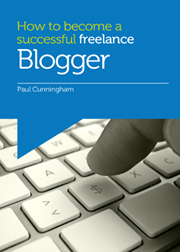
So if you just want to write, rather than to try to find ways to make money with your blog (and trying to keep up with the tasks that come with it), you can also choose to write blog posts for other people. This is where Paul Cunningham’s How to Become A Successful Freelance Blogger e-book comes in.

How to Be A Successful Freelance Blogger- bookcover
image via bloggingteacher.com

In this e-book, Paul talks about every aspect of blogging for others, including:

–           how you decide this is the right path for you,

–          what qualities you need to make it as a freelance blogger,

–           how you can set goals & manage your time,

–          how  to decide on your price/post,

–          how to develop a portfolio to help you land gigs,

–          tips on managing your income,

–          places to look for blogging jobs,

–          ways to find jobs that are not advertised,

–          what to include in contracts,

–          managing your relationship with editors,

–          writing your very first post

and more.


Simply put, How to Become a Successful Freelance Blogger takes your hand from the first moment you decide you want to build a career as a freelance blogger and takes you step by step.

The book consists of 45 pages, ending with a list of useful web resources. While I am not going to say it is the only book you need, it is a pretty comprehensive book that covers the needs of both beginners, and those who feel like they could use some direction and tips while managing their careers.

Paul blogs on bloggingteacher.com, where he gives a lot of useful tips on every aspect of blogging. The site also comes with a page that allows you to submit your idea and post if you want to try guest-posting (a concept Paul also covers in How to Become a Successful Freelance Blogger.

The book is priced at $24. Yes, I have it, and yes – I used affiliate links.

Click here to view more details


Related Posts Plugin for WordPress, Blogger...

Filed Under: E-Book Reviews, Recommended Resources Tagged With: blogging teacher, blogging tips, ebook review, freelance blogging, how to be successful freelance blogger, paul cunningham

  • « Previous Page
  • 1
  • …
  • 71
  • 72
  • 73
  • 74
  • 75
  • 76
  • Next Page »

Blogroll

  • My Entertainment Blog

My Other Blogs

  • Beauty, Fitness & Style for the Fun-Loving Gal
  • Dating & Relationships in the 21st Century

Categories

  • Author Interviews
  • Author news and coverage
  • Blogging
  • Book Launches and Excerpts
  • Book News and Author Interviews
  • Book Recommendations
  • Book Reviews
  • Career Management for Writers
  • E-Book Reviews
  • Fiction Writing
  • Fictional Writers: Writer Characters in Movies, TV Series and Books
  • Inspiration and Motivation
  • Marketing
  • Marketing Fiction
  • Movie and TV Series Recommendations
  • Novel Reviews
  • Paying Markets-Web and Print
  • Productivity & Time Management
  • Recommended Resources
  • Reviews for Tools and Devices
  • Romance
  • screenwriting
  • Self-publishing
  • Story Conflicts
  • Website & Blog Reviews
  • Writer Tools
  • Writing
  • Writing Tools
  • Writing Updates

Copyright © 2026 · Focus Pro Theme on Genesis Framework · WordPress · Log in

This website uses cookies to improve your experience. We'll assume you're ok with this, but you can opt-out if you wish.Accept Reject Read More
Privacy & Cookies Policy

Privacy Overview

This website uses cookies to improve your experience while you navigate through the website. Out of these, the cookies that are categorized as necessary are stored on your browser as they are essential for the working of basic functionalities of the website. We also use third-party cookies that help us analyze and understand how you use this website. These cookies will be stored in your browser only with your consent. You also have the option to opt-out of these cookies. But opting out of some of these cookies may affect your browsing experience.
Necessary
Always Enabled
Necessary cookies are absolutely essential for the website to function properly. This category only includes cookies that ensures basic functionalities and security features of the website. These cookies do not store any personal information.
Non-necessary
Any cookies that may not be particularly necessary for the website to function and is used specifically to collect user personal data via analytics, ads, other embedded contents are termed as non-necessary cookies. It is mandatory to procure user consent prior to running these cookies on your website.
SAVE & ACCEPT