Addicted to Writing

Manage Your Freelance Writing Career While Writing What You Love

  • About Pinar Tarhan
  • Blog
  • Books
  • Hire Me: Services
  • Contact Me
  • Portfolio
  • Favorite Resources
  • Newsletter

Why I’m Forming My Own Thesaurus

Posted on March 20, 2014 Written by Pinar Tarhan

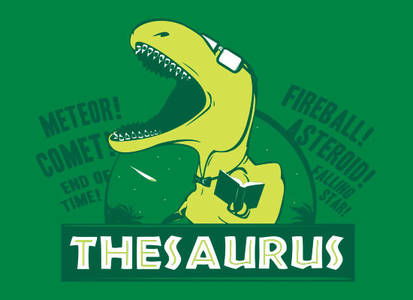
thesaurus
Image via: snorgtees.com

Thesauruses are often one of writers’ best friends, especially in times of drafting and editing. You don’t want to be repetitive. You want the word that sounds just right, and sometimes a nice Thesaurus provides you with some nifty words that for some reason elude your mind.

As someone who still has a fondness for paperbacks, I own an Oxford Thesaurus. I also make use of my built-in one that came with my MacBook Air. I occasionally use dictionary.com.

But I recently took up the habit of making a list of most-needed/liked words and phrases. I’ll be reading an article and I’ll see a word that fits the image I have in my head. I underline the stuff I loved in other books/magazines/blogs…Some of them even served as unintentional writing prompts. Ah…the mysterious (and slightly crazy) mind of the writer…

And let’s face it, while there are many ways your character can walk/enter/move/run…etc., only one or two will describe his mood and speed perfectly without contrasting his personality or situation.

Using the right word also eliminates unnecessary adverbs and adjectives. Don’t get me wrong. I might be the in the minority as a writer as I love those parts of speech. Still, some of them are redundant and if you can make your piece smoother, you go ahead and do it.

So there. I’m, with the help the stuff I’m reading and other Thesauruses at hand, forming my own. Because I know what I need. I know what my characters need.

And it makes the process much faster.

What are your go-to resources for the writing process? Have you thought about collecting your favorite vocabulary? 

To conclude, here’s a funny video from Friends on why we shouldn’t overuse anything, thesauruses.:)

P.S. I was also recommended Chambers Dictionary for Mac.
Filed Under: Fiction Writing, Writing Tagged With: friends joey thesaurus clip, thesaurus for writers, thesaurus for writing, tools for writing, writer tools

Turn-Offs in Novels: Jargon, Foreign Languages and Detailed Description of Very Minor Characters

Posted on March 2, 2014 Written by Pinar Tarhan

I’ve fallen out with a novel I had eagerly bought. I picked it out the ways I always do. I went to one of my favorite bookstores (aka a big store with a decent, varied collection and offering comfy seating and quiet to explore), took 5-10 books whose premise (and genre) I was intrigued by and read a little. I chose the one that appealed to my current reading need: a fun, fast-paced, emotional romance novel. (While I’m also a huge fan of thrillers, I’m working on a romantic/comedy/drama  manuscript myself, it makes more sense to research the market – seeing what sells while getting the escapism I need.)

And it started fine enough. For the first 50/100 pages or so, it was unputdownable. I read it on the bus, on the escalators, before I went to bed… If I wasn’t working (or resting my eyes), I was reading it. Sure, there were some wordy descriptions, a few mentions in a foreign language and some jargon related to the characters’ work. It set the mood. It was sort of relevant. I didn’t mind.

Image via evalblog.com

But then the characters dropped their foreign language randomly in their sentences regularly. Some characters were from that foreign country so it made sense. Regrettably, it wasn’t one of the languages I sort of spoke. No, they went beyond your typical travel phrases or widely-known vocabulary. Then there was the jargon rain. It kept coming and coming.

Now, the book is aimed more at a female audience. The romantic storyline, a typical female character (I’ll get into the “typical” in my next post) and even the job (decoration-related) probably made the majority of female readers happy. But, you see, when it comes to interior design, I’m more like a  guy than a girl . I don’t have an extended furniture vocabulary . Sure, I love shopping and decorating myself, but I don’t want to know the name/root/history of every single thing. So the book slowed down further. I kept giving breaks and then coming back.

The third turn-off was the detailed description of the more minor characters- characters we run into once or twice as the reader. Yes, I could picture them all vividly, but it took me off from the plots and subplots. Now, there are some things the book did very well. The woven storylines, the setting and the dialogue were pretty good. But I started rolling my eyes way too often, and the initial love and enthusiasm disappeared.

The good news is, the book breaks some rules with novel-writing advice. It’s good news, because it proves you can follow your heart, write your novel your own way and get it published. The bad news is, this book isn’t a debut. So the writer had some leeway. First-timers don’t usually have this luxury.

Now, the point is this post isn’t to critique one particular book (hence the absence of the the title and the name of the author), but to spark a discussion about using other languages, jargon, and the amount of details insignificant characters deserve. Basically, this author hasn’t killed her darlings but has given birth to them over and over and over again.

How do you feel about the use of them? How generous are you with these when it comes to your fiction? As for my musings on “typical“ female character, that’ll be in my next post, so please stay tuned. Until then, you can check out the problem with following advice in this post The Problem With Following Advice, and Writing Your Novel Your Way.

Filed Under: Fiction Writing, Writing Tagged With: character descriptions in novels, fiction writing, novel writing, novel writing advice, use of foreign languages in writing, using jargon in writing

The Problem With Following Advice, and Writing Your Novel Your Way

Posted on February 1, 2014 Written by Pinar Tarhan

novel writing
Image via bang2write.com

How good are you at following advice? For me, there is no single answer to this question. It depends on where the said advice comes from (reliability), and whether or not it can match my personality traits and some very rooted habits. Meaning I won’t (and can’t) fool myself into thinking I can take the “get up early” tip of some writers, because before 9 o’clock, I’m cranky, useless, sleepy and yes, unproductive. So instead of having a staring contest with the blank sheets or screen, I get up a little later and get the most out of my awake self.

For instance, I adore John Grisham’s legal thrillers and dramas, but the fact that he got up two hours before work (as in before he headed to the law firm) while working on his first novel makes me think he is an (awesome) alien.

I’m sure you can relate. Maybe not to my sleeping habits, but to how I analyze and decide to internalize or chuck tips from successful people. I can work with “be organized”, because that’s sane advice. I might not be able to keep the tidiest house, but I will clean up the mess before I start working.

Where’s this coming from? I’ve been reading about agents and publishing since I started working on my novel, and while some of the tips make me say “Of course!”, some make me scratch my head and get a bit pessimistic. The latest collection of tips that inspired this post can be read here.

(Some of the tips I couldn’t agree more with are about “dream” starts, verbose paragraphs, laundry lists… Please refer to this post for these to make sense )

The good news is, following some viable advice, combined with a good story and hard work, can get you published. Bad news is, it might kill diversity.

I’m working on a romantic/drama comedy which will probably appeal more to women than man on the basis of its genre. Let’s assume I get published (I haven’t started pitching yet,) and a reader picked it up. Here’s what he/she won’t see:

–       A main female character picking all her physical flaws and insecurities apart in several different places.

I read this sensible tip that says no one wants to read about physically perfect characters. They’re boring and/or hard to relate to. I agree.

But when I mentioned the “beauty” of my characters in this story, I referred to how other people perceived them. For instance one character is confident, playful, free-spirited and cute. She has no problem flirting with men, and this is observed by her friends. Maybe she has crooked teeth, or eyes that are too small for her face or she doesn’t like her nose much. Who cares? Her insecurities are irrelevant to her storyline, so I don’t mention them.

Or let’s take my leading male character. He’s described as handsome in a manly and outdoorsy way. He’s also smart, nice and extremely altruistic. So even before my female lead meets him, she is very intrigued. And because she finds his personality sexy too, she is drawn to him. While their chemistry dominates the scene, I don’t talk about if he is too tall or she’s too short or they’re going through a bad hair day. They might not be everybody’s type. They are certainly not perfect, whether physically or personally. No one is. But as far as their looks are concerned, they are perfect according to each other.

–       First person present tense narrative from this main female character.

I love romance and comedy, and I read a lot of fiction with a female leading character, told from her perspective and in present simple. I like this type of narrative. It’s fun, captivating and quite addictive. But the problem is, as I identify with this 20-something, physically-not-perfect but-can-be- quite-alluring-with-the-right-style character who has some problems at work and her romantic life, I keep wondering what the other characters are like. I get how the lead sees them, but I never get to see what they truly think. You can show and not tell as much as you want, but you are still showing one character’s point of view.

I wanted to study from published and well-received romance novels so I could get an idea of how to tell a romantic drama/comedy using past tense, and with an omniscient narrative. I failed to find such books…There are many thrillers and dramas like this, but romantic comedies? Not really. (If you can think of some, please recommend away!)

So I fumbled through my first novel. I tried to use what worked for me as a reader, and what didn’t. I left out what bored me. I tried to produce the type of story that I’d like to read.

I’m not saying it reinvents the wheel. It doesn’t. I’m not saying it’s not unpredictable, or as catchy as the first-person narratives I’m a big fan of.

But this is the story I wanted to tell. I’m open to critiques, rewrites and notes on it. But since there are numerous authors who have been doing this so well for so long, maybe I can find an agent that will take a shot with me, because it’s a bit different.

I realize that some of the advice I don’t apply might work against me. But for the sake of this story being its own (and mine), I have to reject certain tips, and cross fingers that I made the right call.

*

As always, I welcome all your tips, experiences and opinions.


Recommended Posts on Fiction Writing

Challenges of Writing Your Novel (After Your First Draft) & Resources to Help You Survive and Thrive

Novel Writing Challenges Get Crazier: From 30 Days to 3 Days!

How to Jolt Back To Writing Non-Fiction From Fiction: 13 Tips


Filed Under: Fiction Writing Tagged With: novel writing, novel writing advice, writing a novel, writing advice, writing fiction

So I Wrote My First Short Story (That Wasn’t Required for an English Class)

Posted on December 26, 2013 Written by Pinar Tarhan

short story
Image via brunswick.k12.me.us/

And lived to tell the tale. You might find it weird that I had the need to write about it, but hey, first times can to be special.

And while I have created many blog posts, and a lot of longer fiction (several scripts and a novel), I hadn’t written a short story that wasn’t for a school project. Stories tend to come to me in longer forms and plots. That said, I’ve gotten into reading short stories and discovered some interesting gems.

As for this one, I had this scene in my mind for some time. I didn’t know whether it would be a part of a longer story, but I realized it stood perfectly well on its own. It’s a bit tragicomic, dark, honest and blunt. It’s also definitely not literary fiction, though I’m not sure where it’d fit in genre fiction. Do short (short) stories even have genres?

Anyway, the story is less than 1500 words, and therefore was appropriate for the Writer’s Digest’s now closed Short Short Story Contest.

For me, plots, characters and dialogue carry a lot of value. And I hope I was able to reflect this on this particular story. There is a clear beginning and end, a specific problem that turns out to be a tad ironic and a somewhat relatable character that did something very irrational.

I’m really fond of the story, and since contests are typically long shots, I’ll be researching for other contests and potential markets until the results come out.

Wish me luck.

May inspiration and luck be with you when it comes to your stories, and their publication:)

So have you written short stories?

Related Posts Plugin for WordPress, Blogger...

Filed Under: Fiction Writing, Writing Tagged With: my first short story, short stories, short story, writing short stories

  • « Previous Page
  • 1
  • …
  • 9
  • 10
  • 11
  • 12
  • 13
  • …
  • 16
  • Next Page »

Blogroll

  • My Entertainment Blog

My Other Blogs

  • Beauty, Fitness & Style for the Fun-Loving Gal
  • Dating & Relationships in the 21st Century

Categories

  • Author Interviews
  • Author news and coverage
  • Blogging
  • Book Launches and Excerpts
  • Book News and Author Interviews
  • Book Recommendations
  • Book Reviews
  • Career Management for Writers
  • E-Book Reviews
  • Fiction Writing
  • Fictional Writers: Writer Characters in Movies, TV Series and Books
  • Inspiration and Motivation
  • Marketing
  • Marketing Fiction
  • Movie and TV Series Recommendations
  • Novel Reviews
  • Paying Markets-Web and Print
  • Productivity & Time Management
  • Recommended Resources
  • Reviews for Tools and Devices
  • Romance
  • screenwriting
  • Self-publishing
  • Story Conflicts
  • Website & Blog Reviews
  • Writer Tools
  • Writing
  • Writing Tools
  • Writing Updates

Copyright © 2026 · Focus Pro Theme on Genesis Framework · WordPress · Log in

This website uses cookies to improve your experience. We'll assume you're ok with this, but you can opt-out if you wish.Accept Reject Read More
Privacy & Cookies Policy

Privacy Overview

This website uses cookies to improve your experience while you navigate through the website. Out of these, the cookies that are categorized as necessary are stored on your browser as they are essential for the working of basic functionalities of the website. We also use third-party cookies that help us analyze and understand how you use this website. These cookies will be stored in your browser only with your consent. You also have the option to opt-out of these cookies. But opting out of some of these cookies may affect your browsing experience.
Necessary
Always Enabled
Necessary cookies are absolutely essential for the website to function properly. This category only includes cookies that ensures basic functionalities and security features of the website. These cookies do not store any personal information.
Non-necessary
Any cookies that may not be particularly necessary for the website to function and is used specifically to collect user personal data via analytics, ads, other embedded contents are termed as non-necessary cookies. It is mandatory to procure user consent prior to running these cookies on your website.
SAVE & ACCEPT