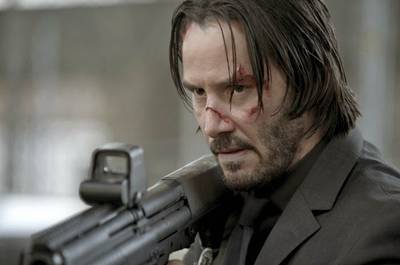
John Wick, Keanu Reeves’ latest movie to hit the theaters is a fun, fast and exciting ride that deserves it’s current IMDB rating of 7.7 (and more). It accomplishes slick action with a budget of 20 mil, and entertains more than a lot of higher budget, CGI-filled action flicks.
And I’d thought it’d be just another ex-hitman-out-for-revenge movie. Sure, it is an ex-hitman-out-for revenge film, but the way it’s handled motive, dialogue, villains and shootouts make it different enough. Briefly put, it’s kept all the necessary clichés to make the protagonist badass enough with a humane side, but it’s eliminated some really too- frequently-used ones.
For instance, instead of a kidnapped/abused/killed family member or romantic partner, this badass seeks revenge because of the murder of his dog and the theft of his car. It could come across as ridiculous and light, but it doesn’t:
You see, our hitman left the world of crime to be with the woman he loved. Cliché, for sure. But let’s face it, we all love a tough male protagonist with a romantic side. He’s fallen hard, and has had a happy relationship until this woman he loved so much dies of a disease. That’s just one.
Why don’t we take a look at how the film manages to set itself apart? Warning: there will be many, many spoilers. Continue at your own risk if you haven’t seen it.
Not a cliché: Beloved wife doesn’t die by the hand of a bad guy.
But she is/was the only live thing he has cared about, and he’s barely buried her when he receives this cutest dog from her a present: she tells him he needs something to love besides his car. He needs not to be alone, he needs to be loved now that she’s not around. So of course he connects with this adorable puppy.
Now imagine a tough-as-they-come, grieving ex-hitman, right at the start of his mourning, being attacked in his home by a stupid, entitled punk (who happens to be the son of Russian mob boss Viggo) Ioef and his friends. The punks kill Wick’s dog, beat the shit out of him (in John’s defense he had no reason to expect a baseball bat from behind in the middle of the night) and steal his car.
Not a cliché: The (stolen) car shop owner is really pissed at Iosef’ s stupidity when he sees the car: he even punches him.
Not a cliché: Viggo calls the owner, and asks why he struck his son, quite calmly. I’d expect an outrage, a team of thugs to beat the guy to death, or something. But this one is quite reasonable compared to many other mob bosses we’ve seen. And when the guy tells him that what his son did, he gets mad with his own son.
Not a cliché: The mob boss is actually quite smart (again, when compared to others). He hits his son, and explains why he did a very stupid thing. And before sending men after Wick (before Wick can kill the son), he calls Wick and asks if they can forget about the whole thing.
He knows exactly what Wick is capable of, and is reasonably scared: It’s refreshing to see a mob boss being realistic about who he’s dealing with, instead of thinking he can destroy anyone.
Realism: John goes out of ammunition, and we see him reload his weapon, take his enemy’s weapon or just use whatever is available to him. No endless ammo here.
Realism: John does get hurt. He does call a doctor. The doctor gives him pills to keep him going. So it’s not just adrenaline (or maybe the pills provide just adrenaline; I’m just pointing out he does get chemical help).
He gets hurt again toward the end, almost dying.
Realism: John calls a “cleaning crew” to rid his house of the bodies.
Fun: Cop shows up after a noise complaint: John did take care of 10-12 men after either shooting them or killing them other ways. There was massive struggle. But the cop asks if John is back to work, he says he is just that taking care of something. Cop leaves, knowing exactly who John is (and used to be).
Fun: A lot of the other humor comes from the fact the way some shooting scene are shot: like we see the victim dropping dead from a single shot before we see John Wick moving ahead coolly.
Funny/tragicomic/different: Viggo cares more about his own life than his son’s: he gives away his son’s location to Wick when Wick corners him and kills all the bodyguards. Of course being a man of his word, Wick lets Viggo go.
Cliché we love: Wick survives after everything, having avenged his dog and his wife’s memory. Realistic? Well, in this movie’s universe…kind of, yeah. After all, Wick is who you send after the bogeyman. Bogeyman is scared of this dude.
*
So in terms of reinventing the genre, Wick doesn’t do it. But what it serves the genre with refreshing elements, well-done, non-flabby dialogue; a decent, semi-dark sense of humor; the right music and perfect casting.
The writer (Derek Kolstad) has picked his clichés well: whatever clichés exist, they do a great job adding to the film’s pace and atmosphere.
A touch of realism here and there makes the film more fun, and gets us even more glued to the screen. I recommend this movie to anyone who loves the revenge thriller genre, whether you also write action thrillers yourself or not.
And remember folks, all clichés aren’t bad. If you know which ones to pick and how and where to implement them, they don’t ruin your story: they improve it.
Speaking of working clichés, you might also enjoy the post When It’s OK to Use Cliches in Your Writing: Hidden Metaphors – Poison’s Bret Michaels Style.

Hi Pinar! This movie sounds great and I’m a Keanu fan. I think sometimes the clichés can be comforting, as long as they are handled carefully as you say.
Hi Pinar! I think the clichés can be comforting sometimes as long as they’re handled carefully, as you say.
Sorry, my answer went missing then returned so I ended up typing it twice!
Hi Yvette,
It’s cool. Thanks for commenting:)
If you like revenge flicks and Keanu, you’ll have a blast with this one. He’s planning a sequel, so fingers crossed.
I agree on some clichés being comforting. Like if I’m watching a comedy, I don’t want a tragic ending. Or if it’s a romantic comedy, the couple should end up together. It’s all about picking your clichés wisely;)