Addicted to Writing

Manage Your Freelance Writing Career While Writing What You Love

  • About Pinar Tarhan
  • Blog
  • Books
  • Hire Me: Services
  • Contact Me
  • Portfolio
  • Favorite Resources
  • Newsletter

6 Great Places to Find Paying Web Writing Markets

Posted on August 29, 2013 Written by Pinar Tarhan

web_writing
Image via paulwords.com.


–9 Awesome (Free & Paid) Places to Find Market Guidelines. This is a post previously published on this blog, and while it also includes magazine markets, most of the resources listed feature many web markets.

– Mediabistro offers avant-garde membership that comes with How-to-Pitch series, where you get detailed, straight-from-the-editor tips on how to query their magazines. There’s also a nice compilation of markets, both online and print.

– 45+ More Websites that Pay You to Contribute an Article, Instantly. This post on Bamidele Onibalusi’s website WritersinCharge is a follow-up to his 30 Websites that Pay You to Contribute an Article, Instantly.

– Sophie Lizard’s free e-book The Ultimate List of Better-Paid Blogging Gigs: 45 Blogs That Will Pay You $50 or More. It only requires a free membership to her highly useful blog Be a Freelance Blogger.

-WOW’s list of paying web markets. Remember WOW is also a paying web market. You can find the guidelines here.

– Carol Tice’s website has a list of markets that pay at least  $50 for guest posts. Scroll towards the end of her guest posting guidelines to check out the markets.

For more help on how to find paying web markets, check out my article 9 Simple Ways Writers Can Find Paying Web Markets on Write Your Revolution.

Go ahead and compile your own gigantic list. Then bring out your ideas notebook, brainstorm some and do some querying.

Good luck, and happy writing!



Filed Under: Writing Tagged With: be a freelance blogger, carol tice, how to find web writing markets, markets for web writers, online writing markets, sophie lizard, web writing, writing for the web

How Mads Mikkelsen and Gerard Butler Can Motivate Writers Like Hell: The Ultimate Gerard Butler and Mads Mikkelsen Guide to Freelance Success

Posted on October 31, 2012 Written by Pinar Tarhan

What can two popular actors possibly have to do with us writers, our careers and motivation levels? First let’s take a look at who and where they are:

Mads Mikkelsen
Mikkelsen image via zimbio.com

Mads Mikkelsen played the James Bond villain in Casino Royale, won Best Actor at Cannes this year, and  he’ll also be starring as Hannibal Lecter. Yep, the very one played by Anthony Hopkins in Silence of the Lambs. Oh, and did I mention he’s Danish?

Gerard Butler
Gerard Butler image via tvtropes.org

Gerard Butler is probably the one you are more familiar with. After all he’s that actor who shouted “This is Sparta” before kicking a cocky Persian right into the bottom of an endless well in the movie 300. He’s known for his dedication to his parts (that Spartan body was really his!), diversity (the guy played the Phantom in Phantom of the Opera), and ability to tackle accents. Why else directors would cast him as American or Irish instead of hiring equally or more popular American or Irish actors?

But whether you like them or their movies isn’t the point. The point is what they accomplished, how they accomplished it and what you can learn from it.

Writers are prone to depression, lack of motivation, bouts of self-doubt, fear of ruts and writer blocks. They also worry about their age, nationality, talent, the competition, rejection, income…and that’s why I like to look at Mikkelsen and Butler when I experience any of those.

1 ) Nationality:

Mads Mikkelsen is from Denmark. Gerard Butler is Scottish. None of them grew up in L.A. Now, if they can make it to Hollywood, you should definitely not be discouraged about your nationality when it comes to your writing.

While your location or citizenship can prevent you from submitting to some magazines (for instance some Canadian publications only work with Canadian writers, or some contests require you to be a legal resident of the country the publication is based in), there are tons of other contests and markets that don’t really care about where you are from. They just want good work.


2) Age:

Butler was 25 when he decided to really pursue acting, instead of just wanting it.  He was 28 in his first onscreen appearance.

Mikkelsen studied acting, but his first onscreen appearance was in 1996, in a short film. He was 31.

Granted, late 20s and early 30s can seem very young, or young enough, depending on how old you are (or how you look at things), but remember that they didn’t start a writing career-they started an acting career, from other countries and competed against people who had been building industry connections since they were pre-teens, whose family members were in the business and so on.

Your queries and manuscripts don’t give a damn about your age. Neither do your editors.

Even if you are trying to write for a magazine whose target audience is way older or younger than you are, it is still all about getting the tone of the publication, understanding what the editors need and coming up with an attractive idea.

Your age doesn’t matter. Not that this is an excuse to delay your career efforts for decades. Make your move now-just don’t obsess over your birth date.

3) Industry connections

Like I mentioned above, Butler and Mikkelsen weren’t born into Hollywood families. I’m not saying the good actors who knew the right people don’t deserve to be where they are. But let’s face it: all things equal, the guy who knows people will be one step ahead of you. He doesn’t even need to be getting favors-he’ll know how things work, he’ll know who to talk to. More studios will know his name. And there is a big chance he has started before you. More experience, better CV and all that.

Imagine you started your writing career without knowing much, if anything, about writing queries, markets, genres, networking….Most of us did. We had to familiarize with ourselves with the process, jargon and fight against people who thought we were dreamers…

The point is that it can be done, whether you initially know someone or not. But once you get started, you have to start building that network of yours. Gerard’s first connection came from a theater backstage gig he got after deciding not to be a lawyer.

4) Background

Not all dancers win Best Actor at Cannes, nor do they get to play Bond villains. And I’m not sure there are many Danish dancers, if any, that got worldwide critical acclaim for their acting, leading and supporting roles in many different countries (not just Denmark, or the States.)

Butler has a law degree from Glasgow University. He just hated his job the moment he started working as an intern.

This is not to say their careers didn’t benefit from those backgrounds. Mikkelsen always has a certain amount of grace he carries around him, and he is not camera shy when it comes to interviews.

Butler always seems like he is chatting with his best friends and having the time of his life during interviews. And the fact that he knew a bit about persuasion and body language didn’t exactly work against him. And hey, knowing what contracts are about can’t have hurt either. Oh, and one of the reasons he was chosen to play the phantom in The Phantom of the Opera was that he had a rock’n’roll voice? Complements of singing in a rock band.

Whatever your day job is/was, there is always something you can use about it to come up with ideas, build relationships, form an audience, etc. You may want to check out Carol Tice’s “How My Crappy Day Jobs Made Me a High-Earning Freelancer” post on Freelance Switch for tips.

Of course your day job doesn’t have to be crappy to help you. John Grisham is a lawyer, in addition to being one of the most famous bestselling authors, who comes up with brilliant legal thrillers and dramas. Needless to say, he doesn’t ever have to worry about using the correct words, seeming off with his descriptions or doing that much research. He also created his first book, second bestseller, A Time to Kill, based on a real life court case he witnessed. A bestseller that went on to become a movie starring A-List actors.

Not that my success is anywhere near his, but I did get published on Carol Tice’s Make a Living Writing with my article “One Freelance Writer’s Surprising Strategy for a Revved-Up Career”,detailing how my part-time job (one that I still have) helped my writing career in so many ways.  Just thought this example might be a tad more relatable than John’s.

5) Persistence, dedication, hard work

If there is any other job that comes with the risk of rejection at least as much as writing, it has to be acting. It’s audition after audition, trying to persuade the director and/or the casting people or the starring actor that you are the best person for the job. It is not easy to pick up your courage and motivation after hearing no, but you do it anyway because the award awaiting for you will make you so much happier than the rejection made you miserable.

Butler’s director in the movie One More Kiss Vadim Jean was quoted to say that he never knew anyone that worked so hard to make his career happen.

That’s the attitude that got him where he is today: sought-after, successful and easy to work with. You are easy and fun to work with if you really want to be where you are, and put in the work where you are. And editors, as well as other clients, love easy and fun to work with.

P.S. John Grisham could only get A Time to Kill published after he finished and found a publisher for The Firm. A Time to Kill wouldn’t have happened if he hadn’t put himself out there again and fight back with another manuscript.

6) Going from fighting for gigs to gigs being offered to you

Gerard Butler played Attila The Hun in the mini-series Attila in 2001. The producers originally wanted someone more famous. And maybe someone with less of a Scottish accent. But they couldn’t find someone they liked better than Butler, and he showed them he could change his accent. 2001 was way before 300, The Phantom of The Opera or P.S. I love You. Before nobody really knew who he was.

People joke that any Danish director casts Mikkelsen whenever they want to secure box office success or awards or both.

More familiar names are not always the best choice. More established writers may not always provide the better ideas.

Or you can improve your blog, establish yourself in the areas you are writing about and have them come to you with offers. Look at Bamidele Onibalusi (of YoungPrePro)’s post to see how he does it.

7) Room for self-improvement, fun and other important things in your life

Mads Mikkelsen speaks Swedish because he lived in Sweden for a while and they couldn’t understand his Danish so he learned Swedish. He speaks German because a German director wanted him as the German lead. He speaks French and Russian because he played Igor Stravinsky in the French film Coco Chanel & Igor Stravinsky. He is obviously fluent in English, having had roles in American movies and constantly giving interviews. And his favorite method for learning languages? Watching movies.

He is also married and raising 2 kids with his wife.

You were saying you couldn’t find the time for…what?

So you are working hard. It doesn’t mean you can’t take time for hobbies, learning, family and friends. Living a full life will make you happier, more full of ideas and more equipped.

8) Proving talents in more areas than one.

Mikkelsen has done drama, romantic drama, period movie, comedy, action, adventure and fantasy, horror, romantic comedy…

Butler has done musical, action, adventure, thriller, horror, drama, romance, romantic comedy, fantasy…

You don’t have to choose between business writing and article writing. Between fiction and non-fiction. You don’t have to pick topic to write about. Go out there, show your best work and keep trying until you get the gigs that make you happy. I don’t know about you, but variety makes me happy.

9) International success

Well, you all have a pretty good idea what these two actors accomplished so far. Why not set your sights on writing for the most established magazines worldwide, writing a best-selling book or being sought-after by well-paying clients worldwide?

You know what it takes. You know it is all about how much (and well) you work, improve and motivate yourself. And you know it doesn’t mean you are not going to have time for other things. In fact, it is all about benefiting from all areas of your life, even things that initially seem like obstacles or motivation-busters so you need to live a life outside of your office too.

*

So go ahead. Work. Live. Have fun. Make it happen. Gerard Butler and Mads Mikkelsen made it happen, and they are only few examples in a very, very long list. Why shouldn’t you?

And don’t worry, I’m a big fan of practicing what I preach. I’m taking my own advice as I keep pitching to publications, running various blogs, having a busy social life and working on my fiction.


Filed Under: Inspiration and Motivation Tagged With: attila, Bamidele Onibalusi, carol tice, freelance writing, freelance writing success, gerard butler, gerard butler movies, John Grisham, mads mikkelsen, mads mikkelsen movies, make a living writing, writers, youngprepro

6 Reasons Why You Should Write About What You Love

Posted on April 24, 2012 Written by Pinar Tarhan

6 Reasons Why You Should Write About What You Love &

(Why I Don’t Work as a Copywriter)

happy writer, content writer
I look this happy and relaxed when I write about what I love. Image via livinggreenmag.com.

Starting and managing a successful freelance writing career while writing about things that interest you, things that you love, is the central theme of this blog. Yes, it features articles about writing and blogging (writing better, finding writing jobs, productivity, marketing your writing, reviews of writing/blogging-related books and products….etc.)

But it doesn’t include any articles about how to become a better copywriter/commercial. There are great blogs on the subject and if you are interested, I strongly recommend you check out the following writers’ blogs (I go to their blogs when I need information on how to write better copy- I have blogs and the pages and my product reviews need good copy after all. I just don’t take copywriting jobs.)

Some of My Favorite Copywriting Resources

–          Carol Tice – Make a Living Writing

–          Peter Bowerman – The Well-Fed Writer

–          Ruth Zive- Ruth Zive Copywriting

So having left that broad topic (copywriting/commercial writing) to the experts, let me tell you why I don’t do it: I just don’t enjoy it!!

Yes, it is a lucrative field, especially if you can educate yourself well – including learning how to get clients that pay well (and you can establish a good, professional relationship with).

But don’t think that I’m a stranger to the field or that I made up my mind without trying. I took the class at university (I double-majored in Business and Advertising so copywriting was a part of the curriculum), I constantly read the tips of the blogs mentioned above along some others) and I applied to copywriting jobs (back when I thought the only way to find writing gigs was to reply to job ads, and I was trying to get clips.)

I didn’t enjoy it one bit. Not the class, not the jobs. I’m  not motivated or inspired.

Being a copywriter – freelance or otherwise- would feel like any other corporate job to me. And I hate cubicles, fixed working hours and supervisors. I’d be miserable doing it, even though it is writing. So I don’t.

I’m guessing you too chose to be a writer, because you love writing. You probably couldn’t stop even if you tried.  It doesn’t matter if you write fiction, non-fiction or both.  And this post is still relevant if you do like copy. Because the question remains: Which would you rather do: Write copy for a website whose topic bores you to death, or a website that you (would) enjoy reading?

So whether you like writing copy or not, below are 5 reasons you should write about what you like:

1) Researching becomes fun. After all, you are writing about something you love finding about- whether it is to find a good query idea or not.

2) Researching is easier. It is much easier to dig deep into your target publications archives because a) there is a chance you are one of the subscribers (so you won’t have to add that to your expenses) or if it is a free publication, or solely an online publication, you probably read a lot of it anyway.

I don’t know about you, but if something has given me a good time and/or extremely useful information, I instinctively internalize it. This is a lot more convenient than getting lost in the research about something that puts you to sleep or frustrates you to no end.

3) You can put yourself in the readers’ shoes more easily. This is closely related to the first two reasons. The right slant is all about knowing the magazine and its audience.

4)  Coming up with ideas is easier. You know the audience, you know the magazine, you know the subject. Now you have everything you need to start brainstorming. Ideas will come naturally. And after you’ve got your ideas, you’ll adjust them with the right slants.

There are some publications that cover topics I’m interested in, and even though I studied them quite a bit, I haven’t been able to get my queries through yet. Why? I had good ideas, but not the right slants. And even though I did some thorough researching, those weren’t publications I read regularly, so it was harder to get to know the target audience as well as I needed to.

 5) You will have fun and you’ll be paid to do so. Below are the lines from a scene from the movie Catch and Release. The guy, Fritz, works in advertising and his hobby is photography.

Fritz: I used to take pictures all the time.

Grey: What happened?

Fritz: Started getting paid for it. Took all the fun out of it.

But unlike our friend Fritz above, getting paid had the opposite effect on me. That effect is reason number 6.

6) Writing has just become more exciting, challenging and fun for me after it became a paying profession.

For instance, I wrote for Freelance Switch three times (my 4th article will be published in May). And when I pitched to guest post for Carol Tice, I had read more posts than I could count. So at first it wasn’t about studying it as a publication, but to learn everything I could about making a living writing.

But before I got the pitch, I dug deeper.  I analyzed the tone, word count, headlines, philosophy, other guest post articles…

I got the gig, and the best part was that %75 of my work had been done before I started writing. It was published, and it also appealed to another freelance writer I admire: Ed Gandia, co-writer of The Wealthy Freelancer.  He wanted to use my article in his e-book Land Work Now (whose review I’ll publish here pretty soon, and my article is there, unchanged.)

*

No matter what you are writing and who you are writing for, you need well-targeted and marketable ideas. These Ideas have to appeal to the publication’s readers. The process of finding your ideas and slants, and ultimately querying,  gets easier if you at least have a little bit of passion/enthusiasm about it.

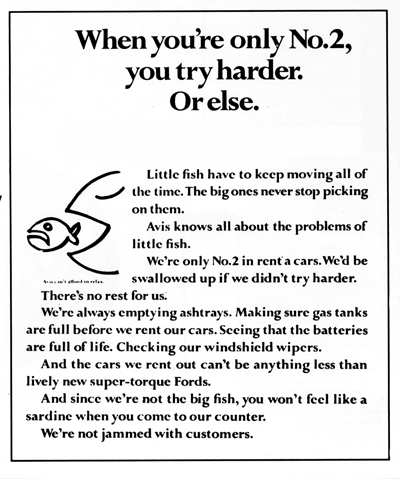
I thought writing advertising copy would be exciting when I was taking introduction classes where we analyzed the good, the bad and the ugly of ad copy. Some of the good were just amazing, and they did wonders. Two of my favorites are below.


volkswagen think small
Image via ideawriters.com


avis we are only number 2
Image via marketingbeyondadvertising.com.


I don’t think these ideas would have come if the people behind it hated their jobs. I’m just saying.


What about you?

Do you love what you are writing? Do write about what you love?

Filed Under: Writing Tagged With: carol tice, copywriting, copywriting resources, ed gandia, freelance writing, peter bowerman, ruth zive, why you should write about things that interest you, writing, writing about you love, writing what you love

This Writer’s Solution for Writing What She Wants: My Guest Post on Carol Tice’s Make a Living Writing

Posted on February 8, 2012 Written by Pinar Tarhan

writing what you love

You know I took October off from writing because I was taking the CELTA course, and then I returned to writing with a vengeance. I’m 19.000 words into my first novel, I’ve been a regular contributor at Europe A LA Carte travel blog, redesigned and revitalized my blogs. Oh, yes, and  I’m really excited to announce that I have a guest post published on Carol Tice’s Make a Living Writing Blog.

Unless you’ve been living under a rock as freelance writer, Carol’s is one of the most popular blogs for writers and it is among my favorites (as One Freelance Writer’s Surprising Strategy for a Revved-Up Career,  as well as being one of the favorites of WritetoDone and Copyblogger.)

I’m having a blast with my writing right now. I no longer have to worry about applying to gigs I’m not passionate about because I have to pay the bills. I no longer have to choose between fiction and non-fiction. I also no longer suffer from the lonely writer blues. So what the hell changed?

Keeping a full time a job gave me depression. Not getting a regular paycheck affected my writing, motivation and productivity badly. So instead I found the perfect solution: I took a job in a field that really excited me, paid me enough without taking too much of my time  and filled in all the missing pieces. I explain it all on One Freelance Writer’s Surprising Strategy for a Revved-Up Career.

Looking forward to your comments!


Image via baneofyourresistance.wordpress.com

Related Posts Plugin for WordPress, Blogger...

Filed Under: Writing Tagged With: carol tice, freelance writing, guest posting, make a living writing, managing your writing career, wite what you love, writing

  • 1
  • 2
  • Next Page »

Blogroll

  • My Entertainment Blog

My Other Blogs

  • Beauty, Fitness & Style for the Fun-Loving Gal
  • Dating & Relationships in the 21st Century

Categories

  • Author Interviews
  • Author news and coverage
  • Blogging
  • Book Launches and Excerpts
  • Book News and Author Interviews
  • Book Recommendations
  • Book Reviews
  • Career Management for Writers
  • E-Book Reviews
  • Fiction Writing
  • Fictional Writers: Writer Characters in Movies, TV Series and Books
  • Inspiration and Motivation
  • Marketing
  • Marketing Fiction
  • Movie and TV Series Recommendations
  • Novel Reviews
  • Paying Markets-Web and Print
  • Productivity & Time Management
  • Recommended Resources
  • Reviews for Tools and Devices
  • Romance
  • screenwriting
  • Self-publishing
  • Story Conflicts
  • Website & Blog Reviews
  • Writer Tools
  • Writing
  • Writing Tools
  • Writing Updates

Copyright © 2026 · Focus Pro Theme on Genesis Framework · WordPress · Log in

This website uses cookies to improve your experience. We'll assume you're ok with this, but you can opt-out if you wish.Accept Reject Read More
Privacy & Cookies Policy

Privacy Overview

This website uses cookies to improve your experience while you navigate through the website. Out of these, the cookies that are categorized as necessary are stored on your browser as they are essential for the working of basic functionalities of the website. We also use third-party cookies that help us analyze and understand how you use this website. These cookies will be stored in your browser only with your consent. You also have the option to opt-out of these cookies. But opting out of some of these cookies may affect your browsing experience.
Necessary
Always Enabled
Necessary cookies are absolutely essential for the website to function properly. This category only includes cookies that ensures basic functionalities and security features of the website. These cookies do not store any personal information.
Non-necessary
Any cookies that may not be particularly necessary for the website to function and is used specifically to collect user personal data via analytics, ads, other embedded contents are termed as non-necessary cookies. It is mandatory to procure user consent prior to running these cookies on your website.
SAVE & ACCEPT