
Addicted to Writing

Manage Your Freelance Writing Career While Writing What You Love

  • About Pinar Tarhan
  • Blog
  • Books
  • Hire Me: Services
  • Contact Me
  • Portfolio
  • Favorite Resources
  • Newsletter

Should You Get a Day Job Until You Make a Full-Time Living from Your Writing?

Posted on August 30, 2018 Written by Pinar Tarhan

Every once in a while, I will catch a TV series or a movie where I’ll envy the full-time jobs and careers of the characters: The offices, perks, comradery, co-workers, the regular salary, insurance, potential for office romance no matter how tricky… And I’ll be a bit sad remembering that it is probably not going to happen for me, and that is my choice.

Then I’ll also read a semi-joking tweet or sometimes even an entire essay on the harsh realities of the gig economy and will feel like crying.

Because no matter how you look at it, making a living with your writing is hard work. Making a decent, regular, and stable income with your writing is much harder.

If you are just starting out, you might be thinking “You get to work in your PJs and vacation whenever the hell you want. How are you even complaining about the hard work?”

I’m not complaining about that. Working hard is not the problem.

We love writing. Otherwise, no one in their right mind would choose to become a writer. But just because we love writing, it doesn’t mean we love writing about anything and everything. It doesn’t mean we will be good at the other parts of the job such as editing, pitching, and marketing.

Being a freelance writer often comes with a challenge: Either you take on jobs writing about subjects you don’t care about so that you will have the occasional freedom to write about the things you do love, or you write about the things you do love and have the occasional freedom to buy the things you need and want.

So we find ways to diversify our income. We take full-time, part-time or freelance jobs that might or might not be writing-related. We write books, launch blogs, create courses, learn affiliate marketing, coach, consult, and study whenever we can to improve ourselves further.

While I love the freedom of being my own boss, I struggle with all the “jobs” I have to perform to keep my dream career going. I write, edit, pitch, market, read, research, answer calls and emails, and find story ideas.

Finding story ideas often means I have to socialize, which can be hard to find the time for with so many balls I’m juggling. And I shall not spend too much money on my social life because I have to save for my future – namely retirement and a damn good insurance because life is unpredictable.

And because we are busy writing and doing all the time, we risk burning out –which makes vacations crucial to our survival. Which brings us back to money.

Not to mention, when you get sick, the whole company shuts down. Because YOU ARE THE COMPANY.

So should you get a day job while you start earning a good income from your writing? It depends.

It depends on your goals, needs, responsibilities, and health.

  • Are you an extrovert who thrives more when she regularly comes into contact with people?
  • Do you need a stable paycheck for certain expenses?
  • Are you responsible for looking after people other than yourself?
  • Are you more comfortable and creative with a safety net?

Then you might consider supporting yourself with non-freelance work.

Now, there are many freelance writers who earn a lot of money from their work every month. To get there, you need to be more strategic when it comes to identifying your prospective clients and niches. You need to pitch regularly and according to a plan. You need to market yourself where your prospective clients are.

Yes, it can be done.

But if you are more into working for yourself, calling the shots and writing about things that excite you, things get a bit more complicated. It can still be done. It will, however, likely cause more frustration and anxiety in the process.

I’m sorry to say there is no one-size-fits-all sort of answer to this complex situation. You know you better than anyone. It is up to you to weigh the pros and cons.

As for me, a part-time job at an office where the culture appeals to my personality sounds like an amazing idea. Unfortunately, I haven’t yet seen such an office in real life. Yet.

Let’s discuss how you make a living writing in the comments.


Filed Under: Career Management for Writers Tagged With: freelance writing, freelancing, make a living writing, make money writing, writers, writing life

Write Where the Money Is by Robert Earle Howells: E-Book Review

Posted on September 2, 2013 Written by Pinar Tarhan


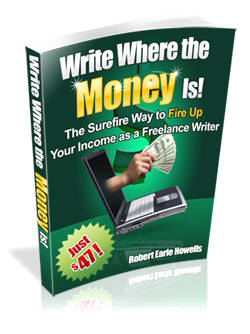
write where the money is e-book
Image via writewherethemoneyis.com.

Write Where the Money is one well-rounded resource that can, and will explain pretty much any question you might have about any stage of writing for a magazine or a website. It was written by veteran writer/blogger Robert Earle Howells.

There are many amazing resources I’ve found about querying, contracts, formatting, writing and such, but I don’t think I have seen all of together, and written so well, in one place.

It’s a must for beginner writers, although it has a lot to teach and/or remind all levels of writers. And even if you’ve been writing and getting published successfully for years, it is still a handy resource to have because it does cover pretty much everything.

It’s a 154-paged PDF document, but it reads as fast as a page-turning work of fiction. Honestly. First time I was reading it, I almost forgot to get off at my bus stop.

But let’s give you more details on why you might need it too.

Below is a breakdown of basically what the book covers, though I interpreted chapter headings to give you a better idea. For the actual chapter names, take a look at the book’s sales page. (Yep, it’s an affiliate link. I stand by the book, and wish I had purchased it much sooner. It’s $47.)

I should mention that all chapters include quotes from other writers, editors and publishers, as well as experiences of Robert, and stuff he used for his own queries. And each chapter ends with a summarized action plan for you.

Here we go:

-How you know if you can write (or know about what to write)

-How to organize your ideas

-Why experience/clips don’t matter as much as good ideas

Now, technically, this is common sense. But it’s easy to get intimidated by our lack of experience in one area even if we have experience in others. So keep in mind that great ideas (and how well you present them) are what matters. And we were all beginners in a niche once.

Just keep brainstorming, and studying publications.

– How/where to get valid experience

He guides you on different strategies to get those first clips.

– What to pay attention to when choosing how to get your clips

– How to write something editors would want (aka how to write well)

– How to study and pitch a publication

– How to understand/interpret writer’s guidelines

There’re some very useful, but not-always mentioned tips on how to read a publication’s guidelines, what to believe and what (not) to take seriously, and what is said vs. what is meant.

– Tips on how to really write a successful query letter

Again, unless you’ve just started writing (congratulations, this is a resource that will get you very far without you having to collect all the information you need about writing, submitting and publishing from a hundred different resources), you are familiar most of the tips. But it’s practical to have a solid checklist.

– What comes after the query, deciphering contract terms, negotiating, rights

The book doesn’t leave you high and dry after sending the query letter. It features insights on how to follow-up, when to give up, how to react to similar ideas published in the same magazine that rejected yours and so on.

Then there’s the breakdown of not just rights, but other terms as well.

– Formatting/submitting

– Working with editors

This part informs you about how to react to edit and rewrite requests professionally; as well as developing long-lasting relationships that will land you assignments without querying (much).

– How much you earn, and how to know an article’s actual worth, what to do when the payment is late

Plenty of magazines do in fact pay a lot better than blogs. Even the publications that pay for both print and online content pay more for the print articles. However, they also happen to expect a lot more in terms of research, experts and interviews.

I’m not saying you shouldn’t do your best when you are writing for the web. You definitely should. However you will see that sometimes an article that pays 3 grand won’t have paid as much as the 50 bucks you got for that 500-word piece for a blog. He explains how.

This section also gives you ideas on how to re-slant your articles and what more you can do with them. Moreover, there’s detailed information service articles vs. feature pieces.

– Defining/finding markets

Different types of publications are explained, along with tips on what to expect from them. Job boards are analyzed. And there’s also information on how to monetize your own blog.

– Qualities you need to become successful: This is divided into two chapters.

And it’s not just about clear writing or being more productive (though they are obviously covered). It pretty much tells you what you need to manage your business, writing and life properly so that you will be a successful writer.

– Wisdom, tips and experiences of fellow writers

This part is great for gaining (and keeping) you faith and confidence.

– Glossary for the writing business terms

– Resource Listing: from markets to associations.

*

All in all, it is a book to keep as a resource as long as you are writing non-fiction. It should be kept where you can refer to as fast as you need, whenever you need it.
Click Here!

Filed Under: Blogging, Recommended Resources, Writing Tagged With: make money from your writing, make money writing, resources for writers, robert earle howells, write where the money is, write where the money is e-book review

Charging for Your Freelance Writing Services: 7 Factors to Consider

Posted on January 9, 2012 Written by Pinar Tarhan

deciding on what to charge for your freelance writing
Image via 3.bp.blogspot.com.


Pricing your work is a tricky issue. You have to know your market, how much your expertise could bring you if you found the right markets, how much you want/need to make, how much time writing for that project will last….So  while tips like “Don underestimate your value“, “Know what you need to earn to make a living as a freelance writer” make for great advice, it is a little bit more complicated than that.

Here’s what you need to pay attention to when pricing your work (and deciding whether or not to take a job with a certain price tag on it):

1)      How will you charge?

  • By the hour?

If you will be paid by the hour, how many hours are you expected to put aside for the project?

Will you be compensated if the work takes more hours than anticipated and agreed upon?

(How) will you be controlled?  Will the client want daily reports, e-mails, skype conferences, office meetings….? Or did you take a job from odesk (a bidding site like Elance) and the client expects you to have your webcam on so that they can keep an eye on you?

It is all very well that you’ll be charged by the hour, but does the job take more than its giving? You have to weigh advantages and disadvantages to decide if the job will be worth it. Don’t just look at the price tag. Look at what the job expects.

  • By project?

If you are paid by the project, you should be clear on the terms. But you should also have a good estimation of how much time will be spent. What if you want to make $50/hour, and you end up making $25/hour because the job took twice as much time and effort you expected?

2)      On how much research it will take?

Again, it comes down to how many hours you will really work on the project.

3)      How demanding is it?

Do you just need to write an opinion post? Or do you need to enhance the piece with expert opinions? Do you need to educate yourself first about the topic before getting all the information you need? And are you expected to just write, or do they want you to find pictures, put the post online, optimize it for the search engines, promote it….?

4)      Do you get other benefits?

Such as byline to your blog, bonus for extra page views, etc…

Some jobs offer a fixed rate, with a promise of a bonus if your article performs well on the web.

While there is no guarantee that your piece will be the next new love of social media, you might feel more motivated to help with the promotion.

For instance, popular web development site SitePoint offers a retainer of $100 to its writers, and bonuses starting from $50 for a certain amount of views. For my details, you can read the write for us page on SitePoint. They also give you a byline, which means more traffic and authority for your site.

I’d love to query them, but they don’t really cover the areas I’d have lots of ideas from. And they do expect a minimum of 1,500 words in length.

5)      How do you get paid?

Will you get by check or PayPal? I’ve always preferred the latter as it is faster, and there are no cuts just because I happen to live in a different country than my editor.

6)      When do you get paid? On publication or the acceptance of your piece?

It is much better to be paid on acceptance. What if you send them the piece, and they decide never to publish it. Or they publish it 8 months later?

7)      Is there future? Or at least a potential for the future?

Do you think this is a one off, or you think you can (or will want to) build relationships so that you might write for them again later?

If you wrote a 2000-piece on a subject you totally hated just to make money, you might not want to return to that topic again. But if you chose an area because you loved it and paid well, you will get to take advantage of your earlier research and your passion for the subject and avoid depression in the process.

For instance, I’d rather spend 60 minutes on a small, fun project and get paid a little less rather than work on weeks for an exhausting and emotionally draining piece that takes ages and its hourly pay will just about amount to what I made from the small project.

*

So your decision depends on many factors including your expertise, project’s and your expectations, your level of passion for the topic, the time it will take, other incentives and more.

Below are some of my favorite resources on deciding what to charge for your work. I might not agree with every point made, but they offer valuable perspectives and I learned a lot from them:


Must- Read Posts and Resources on the topic:

7 Reasons Why I Won’t Write a $15 Blog Post   by Carol Tice

Well, for the record, I’d take a $15 blog job- if you asked me to write a 500-word opinion post on where Mel Gibson’s career is going. He is my favorite actor, I know all the dates of his movies, and I’ve more trivial info on the guy then Wikipedia and imdb.com combined. So yeah, I’d.


If the job was that easy, fun and research-free. So yeah, time and fun are big factors for me. But since blogging jobs are never quite like that, I’d really stick to Carol’s advice.


Mailbag: How Much Can Freelance Writers Charge for Blogging? y by Carol Tice

In response to a reader’s question, Carol offers some tips on how you can get more out of a blogging gigs-given that you pay attention to certain factors.


How much should a freelancer charge?   by Moira Allen

Moira Allen has included some great pointers that I overlooked, such as your relationship with the editor. Just like any job, relationships matter- a lot! Take a look at her post.

Two other incentives for you to devour her post: Writing-World is an amazingly thorough resource for any question to you might have about writing, and it is a paying market. So not only you’ll find helpful information, it will also help your research- should you decide to query the site about writing related topics.


Oh, and on a similar note, Carol pays for guest posts on her blog, so you might want to check my post  5 Authoritative & Popular (Writing / Blogging) Sites That Accept Guest Posts for details.


Writer’s Market’s How Much Should I Charge E-book

Now, I believe this is only free for Writer’s Market members, and it includes a successful survey including low, average and high rates for almost any kind of writing. If you are thinking about become a member of Writer’s Digest’s online market database (Writer’s Market), complimentary e-books is only one of the perks.

Filed Under: Writing Tagged With: charging for freelance writing, freelance writer pay, freelance writing, freelance writing services, make money writing, what to charge for your freelance writing services, writer pay

What Content Mills Can and Can’t Do For You

Posted on October 18, 2011 Written by Pinar Tarhan

content-farm
Image via axandra.com.


The words “mill” and “farm” possibly didn’t have negative rings to them before they were teamed up with “content”. A content farm/mill is a website whose content is produced by hundreds, possibly even thousands of writers. The farm typically offers low pay, presumably accepts low quality content and doesn’t look good on the writer’s resume. In fact, sometimes writers are suggested they leave the content farm completely out – and if possible, don’t write for the content mills at all.   

But just like anything in life, it isn’t all black and white. There are both advantages and disadvantages to writing for these sites, and it is better to go through them all before making up your mind. Yes, I have been there, and done that. I’ll include my own experiences, as well as links to what other writers had to say about them.

(Note: This article features some blogging related jargon, so if you are not familiar with terms such as link-building, seo and such, you should read the post 8 Essential Blogging Terms for Beginners first.)


Pros

–  It helps you experiment with keywords, traffic and seo optimization. If you want to write for the web, you have to have at least a basic knowledge of SEO. Almost all professional writers are recommended to have a website/or blog so that they can showcase their work. And you can’t promote a blog without knowing how/where to use the keywords, or without knowing what these keywords are. So whether you start a blog before or after using these content sites, they actually help you develop your skills. Mostly they offer stats, and many sites compensate according to how much traffic you bring. So you can test your results both in page views and increased earnings.


–  You meet with writers who might be in the same place as you are: You can start building a community there. These writers read and support your work (by promoting it social media), leave comments and encourage you.


– It provides back-links and provides traffic to your site.  Most content farms allow you t link to your articles on their site, and your own blogs. So you can increase traffic to your site, which in turn can result in more readers and advertising revenue.


While article-marketing is not what it is used to be, link-building is still one of the most important elements of site traffic. The more people link to you, the more you easily your site gets found. But of course quality is always better than quantity, so fewer links from stronger sites (e.g. a well-respected, popular blogs) bring a lot more traffic and credibility than weaker sites (e.g. sites filled with content taken from other sites).

You can always google the content site you want to write for, look for its page rank and how many backlinks it generates.


– It helps build confidence as mostly these farms have low expectations from their writers and you have the chance to see your work on the web almost immediately.


– It provides residual income. While they pay for your coffee rather than your rent, you keep earning money long after you stopped publishing.


Cons

–  Sites might change policy faster than you can say “what the…?”. One minute, Associated Content is providing you with a better $ value for 1000 visits, and the next it has joined Yahoo, only U.S. residents can take advantage of the pervious payment methods. Not to mention, they made tons of money in the process while having paid their writers peanuts. Yes, while Associated Content gave its writers a little bit more than some of its competitors, the money they made angered a lot of writer for the site or not.

Bukisa also changed from an approximately $3.2/1000 visitors to google adsense revenue. The good thing about Bukisa was that you could republish content you published elsewhere.

But guess what? Google hates duplicate content, even if it is your own content that you’re republishing. When I was first experimenting with content sites, I believed that I could edit/republish stuff the way I wanted. Well I did. As a result, google deleted my account, costing me about $120 in earnings. So advertising revenue is as unstable as the policies of the content sites. While getting money for your link-building efforts is fun, it is certainly a major disappointment that it can cost you your earnings.

–  It simply takes too much time. Yes, while you see your article published after a short period oftime, it takes time to come up with a decent article, format it their way, add your visuals and then promote it. Most content mills pay you according to the traffic. Remember you also need to work on your own blog, start applying for freelance writing jobs (if you do want to pay your rent – and finding a well-paying freelance job is also tricky) and pitching article ideas to magazines. You will also keep reading to improve yourself. How much time do you really have to try and maximize your earnings from the content sites?


– Showing only your content site credits on your portfolio might cause publications not to take you seriously. While you might lend some of your initial writing jobs with links to your content mill articles, most publications won’t take you seriously. Some writers suggest getting warmed up with a couple of content mill articles and then abandoning them all together.


– The pay is BAD. You do not actually earn you more than a coffee and a donut (per month). Yes, some articles can hit the jackpot and there are some very lucky writers who made hundreds of dollars  through traffic with a handful of articles. But those articles are very rare, and you’d be better off improving your writing and getting published in magazines that will pay you a reasonable  amount (Unfortunately there are magazines who do pay as low as content farms.)

–  They won’t help you develop a thick skin as you can publish anything as long as you follow the guidelines –which doesn’t prepare for you the rejection or no replies you will be getting throughout your querying. And if you want to make money writing, you will need that thick skin.


What Some Professional Freelance Writers Say

Anne Wayman experimented with Triond, Helium and Associated Content. This is one of her reviews.

How One Writer Grew Her Pay — and Left Demand Studios Behind by Tiffany Jansen, guest post on Carol Tice’s Make a Living Writing

How One Freelance Writer Kicked Content Mills and Earned Big by James Patterson, guest post on Carol Tice’s Make a Living Writing

And Carol Tice herself is vehemently (and rightfully)  against any writing  job that pays $15/article.

What to keep in mind

– Some have a better reputation than the others.

– They are free to change policies as they like.

– If they go out of business, there is a chance your articles will disappear from the web.

– Don’t hang out there forever if you want to make a living out of writing.

– Don’t hang out there forever if you want to improve your writing, and reach a wider, more selective audience.

–  Some content sites seem to be more respected than others such as Suite 101, as Anne Wayman of About Freelance Writing didn’t mind promoting it as an affiliate, and Hope C. Clark of Funds for Writers , and Jenn Mattern of All Freelance Writing  (three valuable writer websites that I follow).


Related Posts Plugin for WordPress, Blogger...

Filed Under: Writing Tagged With: associated content, bukisa, carol tice, content farm, content farms, content mill, content mills, content sites, make a living writing, make money writing, pros and cons for writing for content farms, should you write for content farms?, writer pay, writing, writing for content arms

Blogroll

  • My Entertainment Blog

My Other Blogs

  • Beauty, Fitness & Style for the Fun-Loving Gal
  • Dating & Relationships in the 21st Century

Categories

  • Author Interviews
  • Author news and coverage
  • Blogging
  • Book Launches and Excerpts
  • Book News and Author Interviews
  • Book Recommendations
  • Book Reviews
  • Career Management for Writers
  • E-Book Reviews
  • Fiction Writing
  • Fictional Writers: Writer Characters in Movies, TV Series and Books
  • Inspiration and Motivation
  • Marketing
  • Marketing Fiction
  • Movie and TV Series Recommendations
  • Novel Reviews
  • Paying Markets-Web and Print
  • Productivity & Time Management
  • Recommended Resources
  • Reviews for Tools and Devices
  • Romance
  • screenwriting
  • Self-publishing
  • Story Conflicts
  • Website & Blog Reviews
  • Writer Tools
  • Writing
  • Writing Tools
  • Writing Updates

Copyright © 2026 · Focus Pro Theme on Genesis Framework · WordPress · Log in

This website uses cookies to improve your experience. We'll assume you're ok with this, but you can opt-out if you wish.Accept Reject Read More
Privacy & Cookies Policy

Privacy Overview

This website uses cookies to improve your experience while you navigate through the website. Out of these, the cookies that are categorized as necessary are stored on your browser as they are essential for the working of basic functionalities of the website. We also use third-party cookies that help us analyze and understand how you use this website. These cookies will be stored in your browser only with your consent. You also have the option to opt-out of these cookies. But opting out of some of these cookies may affect your browsing experience.
Necessary
Always Enabled
Necessary cookies are absolutely essential for the website to function properly. This category only includes cookies that ensures basic functionalities and security features of the website. These cookies do not store any personal information.
Non-necessary
Any cookies that may not be particularly necessary for the website to function and is used specifically to collect user personal data via analytics, ads, other embedded contents are termed as non-necessary cookies. It is mandatory to procure user consent prior to running these cookies on your website.
SAVE & ACCEPT