Addicted to Writing

Manage Your Freelance Writing Career While Writing What You Love

  • About Pinar Tarhan
  • Blog
  • Books
  • Hire Me: Services
  • Contact Me
  • Portfolio
  • Favorite Resources
  • Newsletter

10 Things You Need to Do After You Sent That Awesome Query Letter

Posted on July 21, 2011 Written by Pinar Tarhan

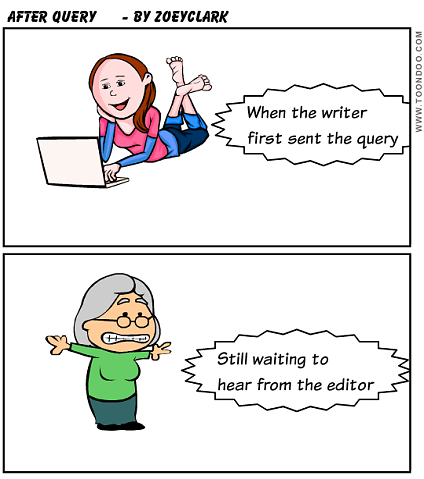
waiting for the editor to reply, writing cartoon
You can't just wait for the editor to reply to your query. If you do, you'll die an unpublished old maid/dude...:) Excuse the cartoon, my first creation ever:)


We all know it’s essential to craft an intriguing, easily readable query letter. That’s how we (hopefully) get the editor’s attention. And if you need to polish your query skills, I suggest reading 7 Great Query Letter Resources: A List of (E-)Books, Articles and Blog Links.

This post is about what happens after having sent that great query letter.

1)      Keep track of your query. I prefer a simple excel sheet. I note when I sent it, when I should follow up (should I not hear from the editor before), what other publications the idea might fit if the query is rejected or doesn’t get a response after the follow-up. I also include a section for brainstorming for other ideas for the same publication. After all, I want to write for this magazine more than once.


2)       Keep researching other markets and their guidelines, and make sure you take notes about the guidelines, payment terms, topics and articles already published on the publication. After all, your querying days are never really over.


3)      Write for, market & optimize your blogs.  If you’ve a writer’s blog, work on it. If you don’t have a writer’s blog already, it’s time to start one. You don’t need to write about writing related topics, but you need to post article samples and links to your published work. The blog will serve as a portfolio, so take full advantage.


Plus, the more you know about blogging, the easier and more fun it will be for you to get blogging jobs, and/or monetize your own blogs.


If you have several blogs, work on them too. They all serve as your portfolios as well, proving your writing skills in those niches.


4)      Keep networking with other writers (and bloggers).


5)      Assuming you heard from the editor before needing to follow up, go ahead and start working on the article – keeping the editor’s notes in mind. Sometimes writing a killer article that will satisfy your editor might be harder than writing the query.


If the editor liked the idea but requests a few tweaks, or another query based on these tweaks,

Do so.


If the editor tells you they liked your style but can’t use that piece, keep querying .


6)      Assuming you didn’t hear from the editors, follow-up on your old queries at the suggested time period.  Many publications offer their response time and when you should follow up if you don’t hear from them in that period. If no specific time is given, follow your gut. If it is a massive magazine, you might want to wait for a couple of months. If it is a website, 2-3 weeks before following up should be fine.


7)      Read about the topics you are writing on. This is great for self-improvement, discovering markets you weren’t aware of, getting to know the markets you know better, finding authors to network and giving you new  article ideas.


8)      Query other publications, and keep track.


9)      When You Get An Answer  or No Answer After the Follow-Up:


  •  If you haven’t heard up from your follow-ups after a couple of weeks, feel free to pitch the idea to other publications. But to be on the safe side, notify the first editor nicely. This is to be on the safe side, and not to burn any potential bridges.


Of course, keep tracking queries and their responses.


  • If you got a no with some suggestions from the editor, keep them in mind. But there’s nothing much you can do after a “no, thanks”. You cross your fingers for the next publication.


10)   Use this list in order and/or mix things up. Add your own points and apply them at a pace that suits you best.


Best of Luck.


Related Posts:

9 Awesome (Free & Paid) Places to Find Market Guidelines

7 Great Query Letter Resources: A List of (E-)Books, Articles and Blog Links
6 Reasons Why Every Writer Should Blog

Filed Under: Writing Tagged With: following up a query, query, sending queries, what writers can do while they wait to hear from the editors, when to follow up on a query, writers, writing

How to Handle Rejection (and When It Might Be A Good Thing)

Posted on June 28, 2011 Written by Pinar Tarhan

Rejection Letters
Rejection Letters. Image via elle.com


Writers are constantly exposed to a form of rejection.  Well, no one likes to be rejected in any area, but we writers need to face the music more often than others. We apply to a lot of writing gigs both online and offline, try to get our stories/novels published, and/ or get our scripts read by producers/agents. And it doesn’t always matter whether we targeted the right market or abided by the guidelines. It doesn’t always make a difference that our writing is good, or the query letters rocked. John Grisham got rejected. J.K. Rowling got rejected.  Do I really need to give more examples?

And having been writing full time since late 2009, I can say that I am pretty much at the start of the rejection cycle. Because although I have been writing since I was basically a preteen, I had never sent my writing to anyone besides my friends. I loved being read and I enjoyed a loyal following that loved what story I would come up with next.

But we all grew up and our lives became much more hectic than just going to school, socializing or dating. We were distracted by our career and family plans. That’s when I finally decided that I was not satisfied with writing just for me and my friends. I also wasn’t going to settle for some job I didn’t want because the economy sucked. It was time to follow my. So I dove straight into heavy research. I studied how magazine queries were made, how articles were formatted. I read about how you could sell your screenplays even if you lived a world away from Hollywood.

I read about blogging and writing, and applied what I learned. In addition to running several blogs, I got some decent gigs and continue to have them. I also keep getting rejected. Here is what I’ve learned so far:


1)      Obviously, your samples won’t impress everyone. For many jobs, you will be either be overqualified or under-qualified. If you are overqualified, the job is highly unlikely to satisfy you.


2)      With some gigs, you’ll have been 10 minutes/2 days/50 applicants too late to have applied.


3)      Job-hunting for writers isn’t all that different from job-hunting for others.


4)      You will be rejected, even if you avoided every rookie mistake you were supposed to avoid.


5)      Many editors will not reply at all.


6)      Some editors will just reply “No, Thanks”, only after you followed up twice.


7)      It is be frustrating, but the acceptance e-mail and the check are all worth it. Yes, I am assuming the check is decent.


8)      You constantly have to work on writing better, marketing and networking. And you need to keep querying.

**

A writer friend of mine recently mentioned that he hated the rejection letters that said that he was a good writer, the story was good but they were just not interested. I hate the letters that don’t come at all, or come very late. I have a whole article about it.

While obviously the news (of rejection) stinks, it at least enables you to move on, and learn. So try not to let it get you down so much. I once read somewhere that the more rejection letters you have in your drawer, the closer you are to being published. And then the author of the article had gone on to list the number of rejection letters famous authors got before they got lucky. The list is quite impressive.

Proof? John Grisham’s first novel is A Time to Kill. His first published worked however is The Firm. A Time to Kill got published after The Firm. Same guy, same style, same quality, both bestsellers. One just happened to be misjudged.

So the ultimate lesson is to hang in there. Your turn will come too, whether it is getting constant magazine gigs, or getting your fiction out there. You are just going to get rejected a lot in the process.


Filed Under: Writing Tagged With: blogging, handling rejection, how to handle rejection, John Grisham, rejection, rejection letters, writers, writing, writing gigs

6 Reasons Why Every Writer Should Blog

Posted on June 25, 2011 Written by Pinar Tarhan


love blogging
image via ezgi.murekkep.org.

The article is short and to the point. It lists 5 reasons why you (as a writer) should blog:

1)      The fun. Life is short and it is very important that if you find something that you enjoy, you should go after it. And if you like writing, there is a chance you’ll like it the colorful world of blogging.
2)      The freedom. Part of t reasons why blogging is so much fun is that you can write about absolutely whatever/whenever and however you want.

3)      Promotion. Do you write? What do you write? What are your strengths? Put in samples, talk about your credentials. It is your platform. Rock on. You can even put on a “hire me” button/page.
4)      Interaction with like-minded people. It is amazing to share what you are passionate about with people who really care about that stuff.
5)      Reputation. Get your name out there. Put in the hours, display the work, write the content. Then fingers crossed, things will eventually go viral- thanks to you and your n networking efforts.  I started because of 1 and I got addicted because of 2. Then I realized, 3 was an opportunity and 4 made it even more fun.
6) Money. It may not the best idea to start blogging purely to make money, as it takes some time to start earning from it. But this is no reason not to monetize your site either. You can sell advertising space, promote others’ products, and a lot more.
Want to read more fun & useful stuff on blogging and writing? You might like:

4 Reasons Why Every Writer Should Use Twitter

Why Every Writer Should Watch ABC’s Mystery Thriller Castle

Filed Under: Blogging, Writing Tagged With: blogging, networking, promotion, reasons for blogging, why writers should blog, writers, writing

9 Productive Things Writers Can Do When They Have a Cold

Posted on June 18, 2011 Written by Pinar Tarhan


Yep, that is exactly how I react when I have a cold…:)

Catching a cold can come in any season. You know the symptoms: dizziness, lack of energy, and low fever. I typically get sick during unstable weather, through a combination of the temperature differences between outdoors and indoors, and the differences between indoors with air-conditioning and indoors with no air–conditioning. Combine it with all the open windows and all the others getting sick and voila: you have a writer with a cold, trying not to vaporize and writing despite a headache.

And while I, unfortunately, discovered that there is no way I can be as productive as my usual healthy self, there are still a lot of productive and not-so-exhausting things I can do. Here is how you can work through a cold if you want to or need to:

1) Facebook: Facebook is a great way to catch up with your friends. And since you are sick, it is OK to start replying to your received messages, as opposed to replying when you are totally healthy and supposed to be doing something else.

But it is not all. You can also promote your old & recent articles. If you are well enough to log on to Facebook, you are well enough for some mindless article promotion. And since you are already active there, browse through groups and fan pages, join the ones you like, join some communities. If you already have a bunch of communities you joined before, converse and leave your own relevant links that will bring value to the conversations. Also, leave links in your messages to your good friends. And don’t neglect to copy-paste your article links to your profile.

Worry not. There is no need to overdo anything. 3-4 article links to your Facebook profile/news update within some hours between them is great for exposure and give your friends time to digest and all.

2) Twitter: Yep, you can tweet about your sickness, but while you are at it, why not post some good links? It can be your old or new article links, friends’ articles, or links to stuff you are promoting. If you can turn on your computer and log on to Twitter, you definitely owe this little activity to yourself.

3) Social Media of Your Choice: Are your readers on Pinterest? Dying to get better results on Instagram? Is it time you experimented with TikTok? You don’t have to take photos or videos when you are sick. But you can play around with hashtags and look at other creators’ content for inspiration. And when you get better, you will realize you’ll have gotten rid of some of your promotional chores for a while. At the very least, you will have conducted some market research.

4) Registering and signing up for useful sites: You may have come across links to register for social media sites, sites that pay for your content, e-mail newsletters you find useful, etc… Registering to multiple sites take time. Since you have time now, use it to sign up for useful stuff.

5) Read blogs and articles: If you are well enough to read, take this time to read friends’ and other’s articles and blog posts. If you can comment, please do. If you don’t have the energy, just help spread the word about the article and let the author know you did this.

6) Check and clean-up your e-mail inbox: You may not feel good enough to study newsletters or apply tips that you are getting from them, but you can always clean out spam and other unwanted stuff. The cleaner your email inbox is, the more productive it will be for you to use it when you feel healthy.

7) Organize bookmarks: How many bookmarks do you have? The idea for this article came to me while I was trying to organize an enormous list of bookmarks. Most of the time, we run into a useful resource, we bookmark it so that we can come back to it later. But since this happens with a lot of sites, we barely ever have the time to go back. Sometimes it is even hard to remember we had a list of websites to visit in the first place.

Do yourself a favor by organizing them. Get rid of the ones you don’t need. If you run into some beneficial stuff, remember to stumble them up, and/or write them down on a Word document, so that you will remember them easily.

8) Take advantage of your entertainment. And if you do watch excess amount of movies and TV shows, remember to write about them later. I once devoured 7 episodes of Supernatural on one sick day. I later wrote a lot of articles on them.

If you have done general reviews for that movie/tv show/whatever already, you can come up with comparison articles, collection of best episodes, list posts and many more.

9) Jot down ideas. When you are physically inactive, your mind can go into overdrive. Make use of these ideas: write them down so you can use them later.

**

So above are things I do when I am not feeling well. What are your tips for “sickness productivity”?

Recommended Articles on Productivity & Time Management

Intelligent Productivity for Freelance Writers by John Soares

How to Use Our Email Accounts Productively to Avoid Procrastination

How to Turn Procrastination into Productivity: 7 Fun Tips for Writers

Related Posts Plugin for WordPress, Blogger...

Filed Under: Productivity & Time Management Tagged With: article promotion, digg, facebook, productivity, productivity tips, productivity tips for writers, stumble upon, twitter, writers, writing, writing tipsproductivity tips

  • « Previous Page
  • 1
  • …
  • 14
  • 15
  • 16
  • 17
  • 18
  • Next Page »

Blogroll

  • My Entertainment Blog

My Other Blogs

  • Beauty, Fitness & Style for the Fun-Loving Gal
  • Dating & Relationships in the 21st Century

Categories

  • Author Interviews
  • Author news and coverage
  • Blogging
  • Book Launches and Excerpts
  • Book News and Author Interviews
  • Book Recommendations
  • Book Reviews
  • Career Management for Writers
  • E-Book Reviews
  • Fiction Writing
  • Fictional Writers: Writer Characters in Movies, TV Series and Books
  • Inspiration and Motivation
  • Marketing
  • Marketing Fiction
  • Movie and TV Series Recommendations
  • Novel Reviews
  • Paying Markets-Web and Print
  • Productivity & Time Management
  • Recommended Resources
  • Reviews for Tools and Devices
  • Romance
  • screenwriting
  • Self-publishing
  • Story Conflicts
  • Website & Blog Reviews
  • Writer Tools
  • Writing
  • Writing Tools
  • Writing Updates

Copyright © 2026 · Focus Pro Theme on Genesis Framework · WordPress · Log in

This website uses cookies to improve your experience. We'll assume you're ok with this, but you can opt-out if you wish.Accept Reject Read More
Privacy & Cookies Policy

Privacy Overview

This website uses cookies to improve your experience while you navigate through the website. Out of these, the cookies that are categorized as necessary are stored on your browser as they are essential for the working of basic functionalities of the website. We also use third-party cookies that help us analyze and understand how you use this website. These cookies will be stored in your browser only with your consent. You also have the option to opt-out of these cookies. But opting out of some of these cookies may affect your browsing experience.
Necessary
Always Enabled
Necessary cookies are absolutely essential for the website to function properly. This category only includes cookies that ensures basic functionalities and security features of the website. These cookies do not store any personal information.
Non-necessary
Any cookies that may not be particularly necessary for the website to function and is used specifically to collect user personal data via analytics, ads, other embedded contents are termed as non-necessary cookies. It is mandatory to procure user consent prior to running these cookies on your website.
SAVE & ACCEPT