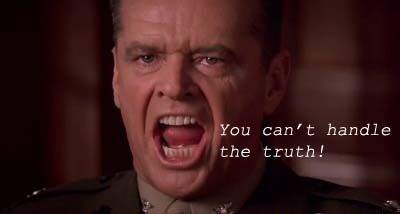
Actor/director/screenwriter Ethan Hawke (Before Sunrise series, Training Day, Dead Poets Society) is quoted to have said dialogue writing is easy; you just have to be honest. While I agree with Hawke that honesty is a must, I don’t necessarily think it makes your job a breeze.
You see, I’m honest to the core when I’m writing a screenplay. I try to keep my characters honest too (as long as they are not delusional, dishonest or just plain evil in nature). And this sometimes causes problems. For instance my dilaogue can be viewed as lacking subtext, and my characters being too precise at expressing themselves.
While I appreciate the importance of subtext, especially when it’s needed to create tension and/or mystery, I’m not a big fan of characters being vague, evasive, or sarcastic just because. Is it wrong to have characters that aren’t afraid of speaking their minds, or characters that are just forthright during their emotional outbursts?
Yes, not all people are like that. But not all people (or great characters) are evasive. I just try to do what works for my story. (It’s not to say upon a reviewing of my script I didn’t make add more subtext, I did.)
But while screenwriting has many, many delightful moments, it also has excruciating ones. I’d love to pick Hawke’s brain on how he made his process so smooth, as I mostly love the writing he does.
And since honesty doesn’t do the trick alone, let’s get some more help on how to write terrific dialogue from the articles below:
How to Win BlueCat by Gordy Hoffman
Gordy Hoffman, who is a screenwriter/screenwriting consultant and the founder of BlueCat Screenplay Writing competition, offers tips that work not just on a competition level. They also serve as great guidelines to edit/rewrite your entire screenplay.
His tips include getting rid of bad jokes, unnecessary/flowery description, making your script as tight (and as short) as possible, rereading and more.
Gordy Hoffman’s screenwriting credits include Love Liza, an offbeat drama comedy starring Philip Seymour Hoffman.
*Note on BlueCat: BlueCat offers something more than your typical contest: written feedback on every submitted script. And if you get to submit before a certain deadline, you can resubmit your edited screenplay. You need to pay for the resubmission, but it’s still a great way to improve your writing, as well as your chances to win.
You can of course disagree with the comments, and choose not to resubmit.
I’ve entered with a feature drama script, after editing an already edited version. This new version is 7 pages shorter, has more subtext and is much tighter. I’m looking forward to the feedback. We’ll see whether I’ll resubmit afterwards.
The Heart and Soul of Screenwriting: Writing Good Dialogue and Description
Also penned by Gordy Hoffman, this article reminds you that you’re writing a screenplay, and not a novel. If you’ve gotten used to killing your darlings in your writing, it’s good news. Because you’ll be killing more darlings than ever.
It also reminds you of the required balance between dialogue and description. You shouldn’t have too much of either. Of course while some screenplays can be exceptions, yours might not necessarily be one of them.
So basically, be coherent and succinct. Give it your best shot. And don’t forget to read the entire article.
SCREENWRITING TIPS FROM A SCREENPLAY CONTEST JUDGE
A judge of the BlueCat contest offers tips that will be useful for getting better contest results. But applying these will make your script more marketable.
Yes, it warns you against typos and grammar mistakes, and doesn’t diverge from Hoffman’s views on dialogue and description. But it also offers some great guidelines when it comes to exposition, using your imagination and more.
How To Write Screenplay Dialogue by Rob Tobin
Rob Tobin is a script reader, doctor and exec who has gone over thousands of scripts.
I love this article because he believes great dialogue writing is a skill that can be learned and improved. He makes his case through a movie that won the Oscar for Best Screenwriting in 1998: Good Will Hunting.
Written by Matt Damon and Ben Affleck, and directed by Gus Van Sant, Good Will Hunting is a delightful movie experience by itself. However, it is, as pointed out, a great screenplay to study as well.
The characters and their lines are often nothing short of brilliant. And the clip of the scene, most mentioned for masterful dialogue, is available on YouTube.
That scene is one of the most memorable scenes in the movie as the trouble-prone Will (Matt Damon) saves his best friend Chuckie (Ben Affleck) from humiliation, and potential jail time (as Chuckie would have proceeded to kick the pampered ass of the meddling Harvard student) just with his self-read and self-earned wisdom and education. This scores him the phone number of one of the girls Chuckie was trying to impress, the satisfaction of having shoved to one obnoxious character (we also cherish the feeling as the audience), as well as showing an interesting irony: Will can’t get out of trouble himself. Let’s be frank, we often crank out some wise advice, while we can’t or don’t follow it ourselves.
As Tobin suggests, it is crucial to know your characters very well. I’ll leave you with this great quote from the article:
“So you want brilliant dialogue? Make it the only dialogue your character can possibly say given who he or she is, where he or she is, and to whom he or she is saying it.”

Hi Pinar,
writing screenplays actually sounds even harder than writing fiction. Let us know what sort of feedback you get on your submission. Best of luck!:-)
Hi Carol,
Screenplay ideas and writing do come more easily to me than say, novels or short stories. But when you are trying to sell to Hollywood, and or impress a judge at a contest….writer’s block or frustration might hit it hard.
I managed to reach quarter finals at two different competitions, though, so that was encouraging:)