Addicted to Writing

Manage Your Freelance Writing Career While Writing What You Love

  • About Pinar Tarhan
  • Blog
  • Books
  • Hire Me: Services
  • Contact Me
  • Portfolio
  • Favorite Resources
  • Newsletter

Too much Exposition vs. Not Enough: Biggest Screenwriting Challenges

Posted on July 17, 2015 Written by Pinar Tarhan

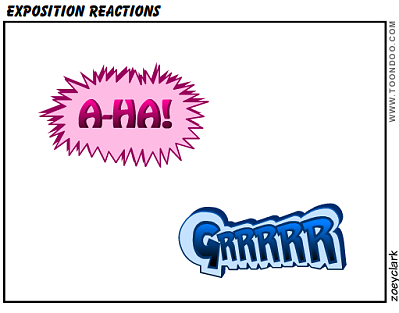
Exposition reactions: The right vs. not enough or too much. And you don't want to piss off readers...
Exposition reactions: The right vs. not enough or too much. And you don’t want to piss off readers…


So you have a written a decent script. You know you have some solid parts, because you’ve been told so by several professional readers, including competition judges. But your script has issues, and some, if not most, of those issues stem from exposition:

  1. You either have too much.

OR

  1. You don’t have enough.

Problem 1: Too much Exposition

You simply reveal too much. You don’t give your reader enough room to interpret and come to their own conclusions. You spoon-feed. You go overboard with description, dialogue, flashbacks… They get bored. They pass on your project or they simply aren’t crazy about it.

This was the problem I was initially facing.

You want to avoid this. But sometimes you work so diligently to avoid unneeded, unwanted exposition that you end up with not enough…

Problem 2: Not Enough Exposition

After many reads by different readers, I thought I had edited my script to perfection, at least exposition-wise. But then some of the notes made me realize: I might have cut too much as these were questioned:

  • Why my characters went to the lengths that they did,
  • Why some characters reacted the way they did.

So you’re not really allowed to let your characters talk directly about their feelings and motivations (also known as on-the-nose dialogue), so you have to include a lot of subtext and show these through action and scenes.

But of course it’s frowned upon to go over 120, even 100 pages unless you are a well-known writer or your script is plain awesome, which you know it, is subjective:

Problem 3: Subjectivity

So how do you know?

1) You compare professional notes. I wrote a guest post on how to evaluate your script evaluations for Lucy V Hay’s Bang2Write.

2) You follow your gut.

*

Finding the right amount of exposition, as well as the right ways to expose, is one though challenge.

If you want to study more about exposition, you might want to start with these articles on Script Magazine or Bang2Write.

You can however find what works by working diligently on your work, as well as studying your favorite screenplays.

How do you feel about exposition? Do let me know in the comments.
 

Filed Under: screenwriting Tagged With: exposition, exposition in screenplays, screenwriting, screenwriting challenges, screenwriting problems

Complicated Conflicts, (Un)Acceptable Character Reactions and What This Means For Your Screenplay

Posted on June 20, 2015 Written by Pinar Tarhan

The Hunt, Mads Mikkelsen
Mads Mikkelsen’s character in The Hunt. His so-called friendly countrymen did that to him. Image via cynic critics.com.

I love interesting conflicts and dilemmas. So much so, I often pick my favorite movie conflicts and analyze them on this blog:

  • The Ledge: Kill Yourself or Your Loved One Will Be Killed
  • The Hunt: Your Daughter’s a Liar or Your Best Friend’s a Pervert
  • Return to Paradise: Spend 6 Years in a Hellish Prison or Your Best Friend Hangs
  • Equilibrium: Live Numb or Die Feeling (Die Being Yourself)

Look at these conflicts!

You either have to commit suicide, or someone will murder the person you love.

You will either live with the guilt of your friend’s death, or you’ll “live” 6 years in prison. Right. And that is if you trust the authorities who gave such an option in the first place.

You either suppress every single emotion and live, or fight for the right to feel and die trying. Ouch…

The Hunt, though, is probably the most heart-breaking one of them all. Either your young daughter was molested by your best friend or she’s lying and you’re screwing up his life for…nothing. Holy Crap!

It is a great, albeit expectedly depressing movie. This 2012 Danish film is still on the top 250 list on IMDB, and I’m shocked it didn’t get the Oscar for best foreign film. (Mads Mikkelsen’s luck, always the nominee movie, never the bride winner).

LET THERE BE SPOILERS FOR THE HUNT and RETURN TO PARADISE

So what would you do if you were the father? What would you do if you are the friend? Because guess what? She’s lying, and he is innocent.

The whole town turns on him for nothing. They don’t even bring in an actual child psychologist. And this almost drives our protagonist insane. I don’t get that when it’s revealed that he’s innocent, he stays in that small town where some people still don’t believe him.

What the f…?

Seriously. Look, I get that he grew up there. His teenage son is there. But are your friends still your friends after they believed the worst about you? And it’s not like he lives in a third world country. There are many more towns and countries he can go to, find work and make money, while minimizing the homesickness. Yes, he has a son, who could in a few years join his dad wherever.

But that is me. I grew up in a big city. I don’t feel homesick much. I don’t mind living abroad. I tried hard to put myself in his shoes. I still don’t agree with what he decided. I wouldn’t look twice at those people.

And the ending doesn’t quite indicate he made the right choice if you are honest about last scene.

However, while the ending might not be the most believable (to me at least), it creates the biggest impact. The director Thomas Vinterberg is also the co-writer, so that presents an advantage. He could shoot the movie the way he wanted.

What does this mean about your screenplay’s conflicts and characters’ reactions?

In my drama feature, I have a story conflict that’s hard to sell. In other words, one of the main character’s actions is extreme, though in line with what he’s going through, and what he has experienced.

And not only are some readers having trouble with the conflict (despite enjoying the premise), they are not particularly fond of how a certain character handles the conflict, which puzzles me.

Because if I were that character, I’d do exactly that.

When I ask people around me what they would in that situation, they choose my character’s way.

So how come some readers aren’t into it?

Well, for one, our personalities and outlooks on life determine a certain percentage of how we react to movies (and screenplays). Remember, a couple of years after seeing The Hunt, I’m still singing the “I would so get out of there!” tune.

Whenever a character takes a cheating spouse back, I’m disappointed until that movie/story ends. Cheaters don’t deserve a second chance in my book, unless the situation is extreme, like the person being cheated on is a complete psychopath or something. You can enjoy my fun cheating-condoning posts on my movie blog.

Some found Death Sentence unrealistic. I tend to love revenge flicks. I cheer for parents who go down the extreme route. Even well-educated, seemingly mild-mannered ones. Because:

  1.  Don’t be afraid, I approve of regular folk taking justice into their own hands only in revenge movies
  2.  I can relate to the pain that will result in losing a loved one. Of course they will go crazy and do drastic things. So while the level of Bacon’s character’s success might not necessarily be the realistic aspect of his movie, his losing it over the not-so-certain outcome of the trial makes sense to me. Yes, Braveheart and The Crow are among my favorite movies. How did you know? 🙂

Anyway…

The point is, we react, judge and interpret differently. I find my character’s action, and the other’s reaction completely in line with their personalities, life experiences.

Would I react the same way if I were in the same situation? Yes. But would I be in the same situation? Not likely. For one, I’m not a musician, and my crow-like voice wouldn’t earn me any fans. So I have my characters, my obsession with the rock music world and my imagination to guide me.

So, we again come back to listening to your gut.

But am I to blame a little? Of course I am. Chances are, I couldn’t reflect the extremity & uniqueness of the situation, as well as I should have.

It feels like mission impossible to balance exposition, good dialog, enough (but not too much) backstory while capturing and holding everyone’s attention in a freaking drama. No matter how engaging I try to make it, it’s still a drama, albeit a glamorous and larger-than-life one at that.

So what do you do?

You work on your craft and draft until the story, the story you know is the right one to tell, shines and eliminates (or minimizes) doubts and let everyone enjoy the ride.

I immensely enjoy the stakes in Return to Paradise. I can honestly say I wouldn’t trust the authorities and go back to save my friend, love or no love. But then again, I wouldn’t do drugs so I wouldn’t be in that situation. That doesn’t stop me from rooting for these characters.

You hear stories about screenwriters who can only sell their 11th script. Then you hear the ones about the first/second or third script they wrote being sold. Who wants to bet there were like 30 drafts of that sold script before it got the greenlight?

Happy rewriting!

Filed Under: screenwriting Tagged With: equilibrium movie, mads mikkelsen, screenplay writing, screenwriting challenges, story conflicts, the hunt movie, the ledge movie

How to Evaluate Your Script Evaluations: My Post on Bang2Write

Posted on June 17, 2015 Written by Pinar Tarhan

In an ideal (and lucky world), your script evaluations would all be positive, and you could start worrying about your pitch after you got your consider or even better, recommend.

But more often than not, you’ll either get a pass or consider with reservations despite your best editing efforts. And different script readers will disagree on pretty much anything.

So you won’t be able to jumpstart editing before deciphering what everyone means, and whether you should consider every tip.

I’m happy to announce that my tips on the subject was published on Lucy V Hay’s Bang2write, a blog I religiously follow.:)

You can click to title to read the article there: 5 Ways To Evaluate Your Feedback by Pinar Tahan aka @zoeyclark


Happy Evaluating!


Filed Under: screenwriting, Writing Tagged With: bang2write, how to evaluate screenwriting feedback, lucy v hay, screenwriting, screenwriting feedback

The Biggest Dialogue-Related Challenge in Screenwriting

Posted on May 10, 2015 Written by Pinar Tarhan

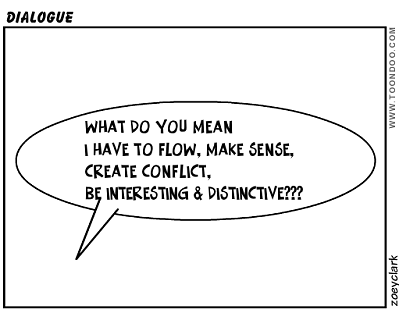
 “Good dialogue clearly conveys emotions, attitudes, strengths, vulnerabilities, and so on, while revealing the details of your plot and advancing your narrative.”

Susan Kouguell, from her article Tips on Writing Dialogue That’s Truthful. 


Dialogue is one of the hardest parts of screenwriting. Just look at its functions perfectly stated by Susan Kouguell. Good dialogue needs to do all that.

And what does good dialogue mean?


Complained your dialogue.


  1. Good dialogue flows.

One way to assure that is by not writing on-the-nose dialogue.

But if it’s never on-the-nose, then you’ll also bore your audience to tears or annoy the hell out of them.

Think about five characters who never ever say what they mean and never mean what they say for 90+ pages. Frankly, I’d end up wanting to strangle them. There have been many movies where I hated the characters for this reason.

However if it’s always on the nose, then you’re destroying your chances for conflict. Also a no-no. It’s a hard balance to strike.

Thanks to some great feedback, I (mostly) dealt with my tendencies to write on-the-nose dialogue. In my defense, I don’t want to eliminate it completely because it’s not realistic then either.

Because people who do mean what they say and say what they mean, at least more than half their lives exist. Exhibit A: Me. I might have to get a little diplomatic or more polite depending on the situation, but if something is wrong, I never, ever say “nothing.” And if I’m upset or not happy about something, I never say “whatever.” Yeah, I’m weird like that.

  1. It needs to be fresh. Witty is great too, if you can pull it off (and it fits the mood).

You can’t write a page-turner by putting the same old clichés everywhere. But then again, it should also sound natural.

All the freshness and wittiness in the world can’t save your script if your character doesn’t sound like an actual person. (If it’s not an actual person, say a robot, an alien from another galaxy or some other special circumstance, never mind.)

  1. And perhaps most importantly, your characters should sound distinctive.

Now, it makes sense. Because in reality, we all have unique speech patterns, our preferred catch phrases, speed, ….. The list goes on.

That said, I’ve always found it easier to “separate” the voices for people who are from different backgrounds. Because the more different they are, the easier it’s to write lines that sound unique to that person.

Think about Pirates of the Caribbean, for starters.

Jack Sparrow: pirate, eccentric, (a little) nutty, morally ambiguous, witty, male.

Elizabeth: a young lady with a free spirit. She’s also well-educated and brave.

Norrington: soldier, by the book, with a distaste for outlaws, not usually able or willing to think outside the box.

How hard can it be to write their lines (and how they speak those lines) so that they are distinct? Making the lines funny and/or smart enough can be the challenge here. But differentiating characters’ way of speaking? Not so much.

The Biggest Dialogue-Writing Challenge in Screenwriting 

So what is, at least for me, more difficult than writing dialogue that’s not on-the-nose, fresh and that hopefully flows?

Making my characters sound distinctive, when their backgrounds and life expectations aren’t so different.

What if your story has to have characters of the same background, identifying with the same culture, who are from the same part of the city, who are of the same sex and age?

When writing dialogue for such characters, I rely on their actions and how they respond to situations. I take advantage of their favorite words/catch , how often they swear (or not) and their personalities.

But what I often find, just not within my own dialogue but within others’ as well, is that I can identify characters according to what they say and their actions, rather than how they say their lines.

As I work on my skills to create more distinguishable dialogue, I asked some of my fiction writer friends how they handle this. Their responses are below:

Glenn Hefley:

“Physical actions are good. I like those more than catch phrases — not sure the preference of my readers, but I like them more. Having one start, then stop and think, then finish in a different direction is my favorite separator – equal to the guy who doesn’t reply for longer than is comfortable.”

Gretchen Mure Rodriguez:

“People tend to use certain words (slang or otherwise) more than others or have quirky habits- how they stand, twirl their hair etc.”

Anna Marie Spackman:

“I always think of motivation. My best friend and I may sound similar or say similar things, but we are motivated by different things, so the way we respond to a given situation will be different.”


***

We started with a quote from Susan Kouguell, so let’s end with one from her.

“Readers should be able to identify who is speaking without needing to read each character heading. Characters’ voices must be distinctive and not interchangeable with other characters.”

Susan Kouguell, from her article Tips on Writing Dialogue That’s Truthful.        

*

Yep, no one said being a screenwriter is easy. How do you handle your dialogue? How do you ensure your characters’ voices are distinctive?


Must-Read Helpful Articles on Dialogue

Column D: Writing Dialogue -The Nose Knows by Drew Yanno

6 Reasons Dialogue Is Your Enemy by Lucy V Hay

Tips on Writing Dialogue That’s Truthful by Susan Kouguell

Dialogue Is The Least Of My Problems by Lucy V Hay

Wendy’s LA4HIRE: Best Screenwriting Tips for Great Dialogue by Wendy Kram

More Than Words: Screenplay Dialogue by Lucy V Hay

Script Mistake # 4: Fatty Dialogue by Lucy V Hay

Related Posts Plugin for WordPress, Blogger...

Filed Under: Fiction Writing, screenwriting Tagged With: best screenwriting articles on dialogue, screenwriting, screenwriting tips, writing distinctive dialogue, writing great dialogue

  • « Previous Page
  • 1
  • …
  • 6
  • 7
  • 8
  • 9
  • 10
  • …
  • 16
  • Next Page »

Blogroll

  • My Entertainment Blog

My Other Blogs

  • Beauty, Fitness & Style for the Fun-Loving Gal
  • Dating & Relationships in the 21st Century

Categories

  • Author Interviews
  • Author news and coverage
  • Blogging
  • Book Launches and Excerpts
  • Book News and Author Interviews
  • Book Recommendations
  • Book Reviews
  • Career Management for Writers
  • E-Book Reviews
  • Fiction Writing
  • Fictional Writers: Writer Characters in Movies, TV Series and Books
  • Inspiration and Motivation
  • Marketing
  • Marketing Fiction
  • Movie and TV Series Recommendations
  • Novel Reviews
  • Paying Markets-Web and Print
  • Productivity & Time Management
  • Recommended Resources
  • Reviews for Tools and Devices
  • Romance
  • screenwriting
  • Self-publishing
  • Story Conflicts
  • Website & Blog Reviews
  • Writer Tools
  • Writing
  • Writing Tools
  • Writing Updates

Copyright © 2026 · Focus Pro Theme on Genesis Framework · WordPress · Log in

This website uses cookies to improve your experience. We'll assume you're ok with this, but you can opt-out if you wish.Accept Reject Read More
Privacy & Cookies Policy

Privacy Overview

This website uses cookies to improve your experience while you navigate through the website. Out of these, the cookies that are categorized as necessary are stored on your browser as they are essential for the working of basic functionalities of the website. We also use third-party cookies that help us analyze and understand how you use this website. These cookies will be stored in your browser only with your consent. You also have the option to opt-out of these cookies. But opting out of some of these cookies may affect your browsing experience.
Necessary
Always Enabled
Necessary cookies are absolutely essential for the website to function properly. This category only includes cookies that ensures basic functionalities and security features of the website. These cookies do not store any personal information.
Non-necessary
Any cookies that may not be particularly necessary for the website to function and is used specifically to collect user personal data via analytics, ads, other embedded contents are termed as non-necessary cookies. It is mandatory to procure user consent prior to running these cookies on your website.
SAVE & ACCEPT