Addicted to Writing

Manage Your Freelance Writing Career While Writing What You Love

  • About Pinar Tarhan
  • Blog
  • Books
  • Hire Me: Services
  • Contact Me
  • Portfolio
  • Favorite Resources
  • Newsletter

Practical Advice About Show and Tell In Writing: One Isn’t Always Evil

Posted on October 31, 2019 Written by Pinar Tarhan

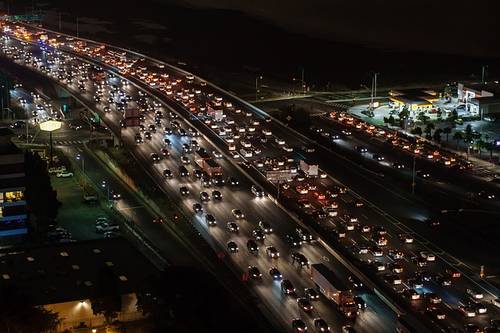
Read up on improving your writing, and you will hit more advice about show vs. tell than cars during rush hour in a big city. So why am I writing about it too?

Because I’ve got something different to say. Brace yourselves. Are you ready? Telling isn’t always bad. Showing isn’t always good.

Still breathing? Still with me? Do you want to come at me with pitchforks, or at least erasers or the delete button?

Hold your horses for a second. And see if you still disagree at the end.

It doesn’t matter if I’m reading fiction or non-fiction. Whether I’m reading an article or a novel, too many people have taken the “Show, Don’t tell” advice to heart.

And the result isn’t as magical and engaging as a lot of writing experts promise.

Why?

Imagine you’re reading a writer who shows and never tells. Not if she can help it. Vivid imagery formed in the reader’s head is better than directly coming out and saying it, right? So let me “show” you, and you tell me when your eyes are starting to droop, and you are stifling more yawns than you care to:

  • Drops were flowing from every pore on Vivian’s skin after her run.
  • The storm shook the wind so violently that most branches didn’t make it.
  • The way Dawson towered over me made me feel like I was looking up at a giant from a fairy tale.
  • The Yankee fans were buying drinks all around, talking over each other and laughing like they hadn’t for a while.
  • I felt like my body was on fire. I stripped down to a tank top and shorts, but I still wanted to throw myself into an ice bath.

I give up. I can’t take it anymore. But you get the idea. Of course, doing the opposite repeatedly is also awful:

  • Vivian sweated way too much.
  • The storm damaged many trees.
  • Dawson was so much taller than me.
  • Yankees won the game, and the fans are happy.
  • It was just really hot.

The idea is to mix and match so that the readers aren’t bored. You don’t want them to be taken away from the story and reminded that they are not really a part of it, that they are just reading.

It’s also important to know when to use which. Here’s a sample I used in my How to Write an Amazing Romance Novel book, which features writing a lot of practical writing advice that can be used for most genres:

  • Older generations considered this to be the mid-life. He was neither a young man nor a middle-aged guy. He wasn’t exactly starting out, but “middle” didn’t ring true as to where he was. People needed to invent a world for him. Mature seemed so finite. Immature days were behind him. Wrinkles had started to play peek-a-boo on his face…
  • He was 35.

I personally prefer the second one, but each to their own. When to pick which also depends on where you are in the story, and where the character is in that given moment. The first one is appropriate if he is feeling a bit lost on the day of his birthday. It is certainly a mistake if he is being chased down the street by a serial killer. Whether you show, tell or do both, your most important mission is not to lose your reader’s attention. They need to remain curious. They need to want to keep the pages turning. Sometimes, falling in love with our words is just as easy as hating them. Try to think like a reader when you edit.

*

How about you? How do you balance show and tell in your writing?


Filed Under: Writing Tagged With: show and tell in writing, show vs tell, writing advice, writing tips

How to Save Your Work and Sanity: A Definitive Guide for Writers

Posted on October 25, 2019 Written by Pinar Tarhan

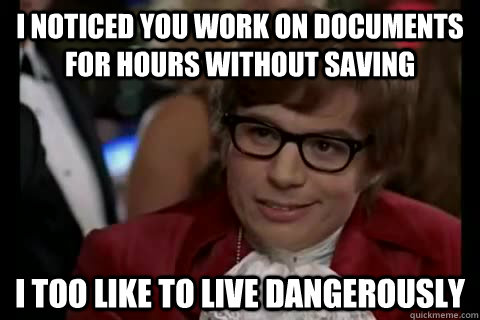
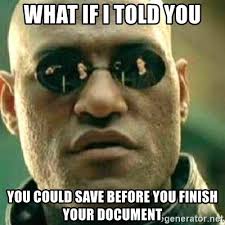
Not me. I play it safe with my documents. 🙂


There is a fun meme on the Internet. I don’t remember the exact wording, but it goes something like this:

“I lost a couple of pages in 1998. Now I push the save button every three seconds.”

This is me. I’ve been using the computer since 94 from the age of 10. After computers became household items, teachers didn’t care for our handwriting in middle school. So we had to type. Which is great, since I tend to write like a doctor when I do it fast. But I have lost some of my work.

So when I was writing my How to Write an Amazing Romance Novel book (Amazon affiliate link), I included an entire chapter on saving your work.

My advice stands no matter the length or type of writing work you are working on. You can pick one, but I’d rather you used multiple tools. Most of them are free, and backing up in more than one space increases the odds of never losing another word again.

  1. Click on the save button whenever you remember, even though it does it automatically.

Regardless of how caught up you are in your project, remember to save as much as you can. You never know when your program will have an error, and you’ll lose anywhere from a few sentences to entire pages.

  1. Dropbox

Dropbox is free to use once you create an account, but make sure you jot down which email address you use in case you lose your password.

Free-to-use services can change terms and storage limits, so don’t make this your only back-up.

  1. Google Drive

Currently, Google Drive for personal use gives me 15 GB for free.

  1. Email

What I said for Dropbox also goes for email services and Google Drive. You never know when your beloved email service might charge you, so this shouldn’t be your only backup.

That said, I always email my documents to myself. This has them stored in two different places (the sent and received inboxes), and they hardly take up any storage space.

  1. Print copy

I love the environment, and I love trees. But I need to have my documents printed. I don’t print posts or articles that take a couple of pages. However, I find it impossible to feel relaxed until I print my longer works like screenplays and novels. This makes editing easier and gives me peace of mind.

  1. USB

USBs (Amazon affiliate link) are practical and relatively cheap alternatives to saving your work. They are easy to carry with lots of documents saved on a tiny device. You don’t always need or can afford an external hard drive, which store and cost much more , not to mention their weight adds up.Not something you’d want to carry with you every day.

  1. External Hard Drive

That said, you do need at least one external hard drive (Amazon affiliate link) for your office.

*

What method(s) do you use to save your work?


Filed Under: Writing Tagged With: how to back up your writing, how to save your work, saving their work for writers, ways to back up writing documents, work saving tips for writers

Story Rights 101: What You Need to Know About Story Rights and When to Hold Out for Better Terms

Posted on October 20, 2019 Written by Pinar Tarhan

In an ideal world, writing would just be about writing.

I think even studying craft or marketing can be fun. I had some great days editing or rewriting. But those things are, as tiring as they might be, easier because they are mostly, if not entirely, under my control.

I can’t control how many of my pitches will be accepted, but I can control what sort of stories I will be pitching. I can also work on my pitching frequency.

But as writers, we must also need to deal with something annoying, mediocre, or awesome depending on the terms of our agreement: Our rights.

What are rights?

Rights are essentially how much ownership and control you are giving your client or publisher. Do they only own the story only in North America? Do they own it in both print, or online? Do the rights revert back to you after a certain period of time, or they own it forever? Do you have ownership should the story be turned into a movie/play/novel, or did you (un)knowingly relinquish that?

Types of Rights

– First North American Serial Rights: FNASR

It means as it sounds. You’re selling the rights to be published in North America once. After publication, rights are yours again.

– Other rights based on geography

Now, while you no longer have the FNASR after this, you can still sell it to Europe, Australia, the UK, etc.

– Rights based on medium

You can also offer first electronic rights for your piece to be published online.
It’s not necessary to know what right means what right off the bat as long as you don’t sign anything blindly.

– Rights based on time

Sometimes, you write a post for a site, and the guidelines indicate you can republish wherever after 30 days. The time can change depending on the pub, but it is in your best interest to check when/if ever you’ll be allowed to republish.

– Movie/TV/book/etc. rights

Who holds the rights, should the story be adapted to a movie, a TV show, a book? A friend of mine recently got a six-figures non-fiction deal through an article she wrote for a respectable pub. Had the pub bought all rights, this wouldn’t be possible.
This is a great example of a pub that respects writers. She got paid well, and she still got to make more money for her efforts as she deserved.

One right you might want to avoid relinquishing: If you can hold your ground, you should keep reprint rights. You should also avoid signing over all rights forever.

Yes, some pubs really do ask for it. And funnily enough, it is usually the guest post site that doesn’t pay or a pub that pays very little.

It is fine if you can never publish the piece anywhere for a month, even a year. But selling all rights permanently gets you paid only once.

*

Please note that my post is meant to be an introduction and a reminder without being too confusing.
For a thorough list of rights and their definitions, I recommend reading and bookmarking this fantastic article on Writing World: Rights: What They Mean and Why They’re Important.

How to Decide When to Fight for More

– Prominence of publication
– Payment
– Relationship with editors
– Your attachment level to the story
– Other writer’s experiences: positive and negative

All the points above are meant to help you ask and answer this question: “Is it worth it?”
I’d love to be published by Vanity Fair, for instance. So I could see myself giving up a bit more to obtain that byline. It also depends on the paycheck. You may not (and should not) be ready to give up on too many rights if you are offered a couple of hundred bucks. But what if you are getting more zeroes in your paycheck?

Still, only you can decide if it is worth it.

Early in my career, there was a publication in one of my favorite niches. They published from new and experienced writers alike, as long as your pitch and writing were solid. The only problem was they bough all electronic rights permanently. It was all very good when the site was online. I could show it as my portfolio pieces with the comments and shares along with my byline. Even though I save religiously, I haven’t saved all these pieces when they were online. And now I can’t find some of the drafts.

You live, you learn.

In theory, I could resell the pieces to print magazines. But there are few print magazines dedicated to writing and freelancing. Not all of them accept reprints (even though your article was only published online), and each magazine, even if it is in the same niche, operates differently. Some base editorial calendars on themes, so your idea may not match for months – if at all.

It’s your story, your baby, your career and your livelihood.

Filed Under: Writing Tagged With: rights basics for writers, rights for writers, writing rights

7 Things to Never Say to or Ask a Writer

Posted on July 13, 2019 Written by Pinar Tarhan

This writer was probably asked/told one of these things before this picture was taken. 🙂

While this post targets the non-writers in our lives, I thought it’d be a fun read, and one you can just save and show whenever weird or unwelcome questions about writing bother you. 🙂

And if you have anything to add, please do so in the comments!

*

There is a rare breed of writers who have thick skin. They never get offended, annoyed, or upset. The unluckier but more common group, however, just learn to deal with these emotions. We develop ways to remain professional and calm while dealing with the turmoil inside.

Then we probably create a fictional character inspired by you and make sure that character gets what’s coming to them. Hey, it is fiction. Anything is allowed.

Look, we get it. We are in a weird profession. Many of the curious folk who utter these words mean well. They either want to find out more or don’t want us to suffer any more than we already do. But they inadvertently get under our skin.

Because despite all the love, passion, fun, entertainment, and satisfaction writing fills us with, we manage a lot of unpredictability, instability, rejection, fear, creative blocks and anger (and then some!) on a daily basis. So we don’t need any more negativity from other sources, especially if those sources are family and friends.

It is an easy list. Go ahead, internalize it. The writers in your life will love you more for it.

  • Get a real/another job.

Fun fact: we actually like money.

We don’t need to be rolling in it to feel happy or complete, but we recognize it as a necessary tool to survive and thrive in the world. We don’t need yachts, extra homes, or opulence (I’m not saying we object to those things. I’m just pointing out that we don’t need them), but we do need health insurance, food, shelter, some savings, and a bit more dough for the little social things that make life a bit more enjoyable: like the occasional meal out, seeing our favorite actors on the big screen, or going on a short vacation.

So if our writing isn’t bringing us enough money for the time period, we will get a job. Math might not be our favorite subject in the world, but we get the equation involving expenses and money earned.

Exceptions, of course, do exist. If we trust your judgment and ideas, we might ask you to brainstorm with us on ways we can get a better job or make more money. Then, please, share your ideas away. We asked for it.

  • Aren’t you wasting your education/training/intelligence/skills/previous job experience?

What we studied in school, whatever jobs we held don’t matter in the slightest if that is not the area we want to work in.

It doesn’t matter that we busted our asses getting into college to study law/medicine/engineering/business/advertising/whatever. If we wanted to work in these areas, we would. (Some of us are, but hey, you wouldn’t be asking them this question.)

We spend 1/3 of our lives at work. Imagine that. Why would you want or expect us to do anything other than we love?

Maybe we studied something for years before we realized it wasn’t for us. It’d be depressing to see that as wasted time. Instead, we learned a lot about something and moved on.

Did you know that Dave Evans, the co-author of the New York Times best-selling book Designing Your Life: Build the Perfect Career, Step by Step (aff. link)  who is a designer and a design professor, first intended to be a marine biologist? As a fan of the book, I for one am glad he carved a different path. (And he carved it because he discovered he didn’t enjoy being a biologist.)

Maybe we are writing about the areas we studied in. We are creating characters who work in those industries or penning non-fiction pieces we managed to get from editors – you guessed it – by mentioning our education and any work experience.

When I’m not writing, I can be found teaching English to adults. When I teach Business English, unlike a lot of teachers, I don’t have to spend hours familiarizing myself with the jargon or finding interesting industry examples to help them learn better. Why? Because I did study business and advertising in college. I didn’t get a job in advertising because I don’t enjoy it. I do. That’s why I studied it. I just don’t love it enough to dedicate 1/3 of my life to it.

  • So is John Grisham/Stephen King/J.K. Rowling on your speed dial?

This might be just about me.

Sorry to disappoint you, but I don’t know any famous writers. Although I know a plethora of authors, none of them are household names yet. But fingers crossed, one day they will be. They deserve it.

  • Can you make money writing/Do you make money?

Yes, you can make money writing.

Did you know I once got $400 for expressing my opinion? While there is a lot more to writing an op-ed than  just telling people what I think, it doesn’t change the fact that there is money in a writing career.

When you can sell many copies of your books, you also make money. If you option or sell your script, you make money.

But do people regularly ask you your salary? Why are you so concerned with ours?

  • How do you make money?

OK, actually this question is allowed if we have entered an interesting conversation about the nuts and bolts of how a writing career works. You are also allowed to ask it if you are a budding writer who wants to learn or another experienced writer who wants to compare notes.

You are not allowed to ask it, however, in a condescending, shocked, or worried tone.

Yes, we make money. But we would also keep writing if we weren’t. That doesn’t give anyone the right not to pay us what we deserve. It just means that we feel compelled to share our written words with the outside world.

When I was in high school, I created a romantic comedy TV-series. I wrote it in screenplay format, printed out, and handed interested friends the episodes in order. We talked about their favorite events and characters, what they hoped would happen, what worked well and what didn’t.

I learned a lot, but I also had so much fun. I didn’t make a dime, but I got read. It was glorious.

Because I am a writer. I write.

  • How will you retire?

We won’t! I mean we save money for emergencies and contingencies, but we won’t quit if we can help it. That is the whole point. For us, it is not just a job or career. It is a calling. It is a part of us. We are always filled with stories.

  • What do you write?

How much time have you got?

Technically, there is nothing wrong with it if you ask a writer who only writes in one genre or niche, but most writers won’t a short answer.

Unless you are an agent, manager, editor, or a producer, you won’t get an “elevator” version.

My short answer is: Screenplays, novels, and non-fiction.

Longer answer: I write romantic comedies and dramas. With non-fiction, I generally cover lifestyle topics in essays, blog posts, articles, or op-eds. It is a shorter list if I go over what I don’t write about than what I do.

*

Don’t get us wrong. We like it when people are interested in us and in our work. We don’t mind questions that every profession begets. We are just tired of people who treat us like weird creatures living life in a fantasy bubble that don’t know how the world works.

We know exactly how the world works. That’s why so many of us became writers. To change it, enhance it, to make it better.

So the question is, will you behave, or will you become the villain in our next story?

Related Posts Plugin for WordPress, Blogger...

Filed Under: Writing Tagged With: what not to say to a writer, writer life, writers, writing, writing life

  • « Previous Page
  • 1
  • …
  • 12
  • 13
  • 14
  • 15
  • 16
  • …
  • 50
  • Next Page »

Blogroll

  • My Entertainment Blog

My Other Blogs

  • Beauty, Fitness & Style for the Fun-Loving Gal
  • Dating & Relationships in the 21st Century

Categories

  • Author Interviews
  • Author news and coverage
  • Blogging
  • Book Launches and Excerpts
  • Book News and Author Interviews
  • Book Recommendations
  • Book Reviews
  • Career Management for Writers
  • E-Book Reviews
  • Fiction Writing
  • Fictional Writers: Writer Characters in Movies, TV Series and Books
  • Inspiration and Motivation
  • Marketing
  • Marketing Fiction
  • Movie and TV Series Recommendations
  • Novel Reviews
  • Paying Markets-Web and Print
  • Productivity & Time Management
  • Recommended Resources
  • Reviews for Tools and Devices
  • Romance
  • screenwriting
  • Self-publishing
  • Story Conflicts
  • Website & Blog Reviews
  • Writer Tools
  • Writing
  • Writing Tools
  • Writing Updates

Copyright © 2026 · Focus Pro Theme on Genesis Framework · WordPress · Log in

This website uses cookies to improve your experience. We'll assume you're ok with this, but you can opt-out if you wish.Accept Reject Read More
Privacy & Cookies Policy

Privacy Overview

This website uses cookies to improve your experience while you navigate through the website. Out of these, the cookies that are categorized as necessary are stored on your browser as they are essential for the working of basic functionalities of the website. We also use third-party cookies that help us analyze and understand how you use this website. These cookies will be stored in your browser only with your consent. You also have the option to opt-out of these cookies. But opting out of some of these cookies may affect your browsing experience.
Necessary
Always Enabled
Necessary cookies are absolutely essential for the website to function properly. This category only includes cookies that ensures basic functionalities and security features of the website. These cookies do not store any personal information.
Non-necessary
Any cookies that may not be particularly necessary for the website to function and is used specifically to collect user personal data via analytics, ads, other embedded contents are termed as non-necessary cookies. It is mandatory to procure user consent prior to running these cookies on your website.
SAVE & ACCEPT